Why Do We Keep Trying to Prove We Loved More?
A public letter to a former lover reveals how imagination, old wounds, and memory rewrite intimate relationships.
People say the best way to forget someone is to turn them into literature.
But literature is not forgetting. It simply gives a feeling with nowhere to go another place to live.
Not long ago, a public letter to a former lover brought a finished relationship back before a crowd. By the end, those thousands of words did not necessarily seem to be asking a former lover to concede anything. They read more like an attempt to give an unanswered love an ending the writer could live with.
Nobody needs a former partner’s permission to know they loved sincerely. What traps us is the conversion of love into comparison: who cared more, who gave more, who was the one truly hurt.
Once love must produce a winner, memory starts collecting evidence. Once the story is told to a crowd, memory starts looking for witnesses.
A phone lights up. The screen holds only two words: “Talk later.” One person glances and sets it down; the other stares at the period as their stomach tightens. Nothing has happened at the far end of the chat, yet the relationship has already ended once inside their mind.
The same two words can mean “I’m busy” to one person and “You’re getting ready to leave” to another. The harder one tries to make the love unmistakable, the more the other wants to escape.
The letter read like an adult’s late submission to China’s New Concept Writing Competition: love was the prompt, two people appeared on the page, but only one ever held the pen.
We cannot use a one-sided account to settle what happened, much less diagnose anyone’s personality, attachment style, or childhood. Yet this page reveals three patterns that return across relationships: how we mistake imagination for love, carry old wounds into an ordinary sentence, and, after loss, rewrite memory into testimony for our own side.
1. We Often Fall in Love with More Than the Person in Front of Us
Attraction often begins when we still know very little. It may be a photograph, a poised answer in an interview, or a glance across a crowded room. Before the other person has come close, a few moments have already formed a complete portrait: someone who should understand silence, who should not leave the way others did, who should stand beside us when no one else does.
People at a distance rarely disappoint the imagination. We have not yet watched them turn curt when tired or seen the ordinary habits that will grate against our own. What we can see is small. The rest of the blank space is filled by longing.
A song puts it simply:
What we cannot have is what keeps stirring.
The line moves us not necessarily because the distant person is better. The red rose and the white rose in Eileen Chang’s fiction are sometimes less like two people than two versions of the same person: one preserved in imagination, the other brought home to groceries, bills, and dishes in the sink.
Psychology calls this habit of completing blank spaces with desire “idealization.” It is not always harmful. In responsive relationships, seeing a partner through a generous lens can increase satisfaction and make both people more willing to stay. The problem is not imagination itself, but whether the portrait in our mind still allows the living person before us to revise it.
Good love casts a gentle light on the other person and still lets them remain themselves inside it.

He habitually arrives twenty minutes early; she tends to leave home at the last possible moment. At first he calls her spontaneous, and she calls him dependable. Years later he still waits, and she is still late. But the same twenty minutes now tell one person, “You do not care about me,” while the other hears, “Even time must obey your rules.”
No one became a different person overnight. What changed was the meaning each partner assigned to the other. Traits admired in the beginning become evidence for the prosecution once anxiety enters the room. A partner’s world also enters the boundaries of the self. Psychology calls this “self-expansion”: their music, friends, familiar streets, and picture of the future begin to take up space inside our own life.
We often love not only the person before us but also the version of ourselves who appears beside them: more open, more courageous, more willing to believe in tomorrow. After a breakup, what is hardest to release is not merely a key or a box of belongings. It is the self we thought existed only in that person’s company.
Only later do we realize that the songs we learned to hear, the friends we came to know, and the abilities we developed have already grown into us. They do not have to be returned when the relationship ends.
Long-term partners can indeed seem alike. One sets down a cup of coffee and the other is already sliding the sugar across the table. They laugh at the same beat in an old joke. One starts a sentence, and the other knows how it ends. Friends say they are growing more similar. What often converges, however, is not the face and not necessarily the personality. It is the rhythm worn smooth by shared life.
Research offers a more restrained answer. One study followed 1,180 couples for as long as sixteen years and found that some personality similarities were already present when the couples began living together; they did not grow increasingly alike. Another large study found that shared goals and values offered only limited help in predicting satisfaction and stability. How each partner meets life often matters more.
So should we look for similarity or complementarity? There is no universal formula. People are generally drawn to those who resemble them. Yet one study found that higher-quality couples were often similar in warmth and friendliness while complementing each other in who takes initiative and who is more willing to make space. Goodwill is the ground; differences in decisiveness or ease can sometimes make daily life work better.
But “opposites attract” is easily romanticized. One partner makes every decision while the other always gives way. One relentlessly pursues while the other endlessly retreats. The fit can look perfect and still be unhealthy.
Useful complementarity means abilities can differ while power remains equal. Useful similarity means core values can meet without two people becoming the same person.
Instead of asking only whether your personalities match, ask three things: Can important decisions be negotiated? Can conflict be repaired? When one person grows, can the other make room for the change?
Psychologists call another kind of likeness “shared reality.” Two people gradually develop a common way of looking: they know what deserves seriousness and which joke only the other will understand. It does not require agreement on everything or abandoning oneself. It is the “way we see the world” that slowly forms through misunderstanding and repair.
Couples who last do not become indistinguishable. They become clearer about which differences may remain and which important questions must be answered together. Money, fidelity, children, care, and the future may not come with ready-made agreement. What matters is whether both people can bring the differences to the table and negotiate a life each can inhabit.
They may remain two distinct temperaments while learning the same responsibility. One stops interrogating when fear rises; the other stops vanishing without a word. One learns to move closer; the other remembers to come back. The best version of “growing alike” is not mutual imitation. It is two people becoming more capable of love and accountability.
But when a partner’s hesitation no longer means only a disagreement and begins to threaten the question “Am I worthy of love?”, an ordinary message can become unbearably heavy.
2. Why Can “Talk Later” Sound Like the Beginning of Goodbye?
The anxiety rarely ends with that first tightening in the stomach. One person asks, “What’s wrong?” A few minutes later comes another message: “Are you angry?” The other is in a meeting. As the notifications keep appearing, they turn the phone face down. The silence confirms the anxious partner’s fear: something really is wrong. At first there was only an ordinary “Talk later.” After several rounds, one person is genuinely chasing and the other is genuinely hiding.
Psychologists call this tendency to detect distance before others do “rejection sensitivity.” The more someone fears rejection, the more likely they are to read coldness into an ambiguous signal and respond intensely. Before the other person has left, the body has already entered the state of losing them.
In attachment theory, a healthy partner can be both a “safe haven” to return to when we are tired and a “secure base” from which to explore the world. Depending on someone is not weakness. The burden begins when every ounce of safety, along with the verdict on whether we deserve love, is placed in another person’s hands.
A message becomes heavy because it can awaken more than the present silence. It touches an older wait: How did this person first learn whether others were reliable and whether they themselves were worth returning for?
Some children once waited for an adult who did not arrive on time. Every footstep in the stairwell made them look up, until it stopped at someone else’s door and their eyes lowered again. Other children learned a different danger: boundaries that were never allowed to close. Sadness had to be explained at once. A shut door was pushed open. Solitude was treated as wrongdoing.
Repeated experiences become the earliest “relationship draft.” Years later, some people fear that no one is outside the door; others fear the door will be forced open. The first may experience distance as abandonment. The second may experience closeness as engulfment.

Early experience leaves a tendency, not a script. Parental separation, inconsistent care, or family conflict can shape how someone understands relationships, but none can dictate the outcome of an adult love. Similar childhoods can yield very different lives. Later relationships and experiences keep revising the draft.
In The Courage to Be Disliked, Ichiro Kishimi and Fumitake Koga draw on Adlerian psychology to ask an uncomfortable but useful question: Can the shadow of childhood sometimes become a reason we use to avoid change? When someone says, “I was ignored as a child, so I can only keep demanding reassurance,” or “I was controlled before, so I can only close the door and run,” the past is no longer merely explaining the present. It has begun deciding it.
This does not mean trauma is unreal, nor does it make an injured person responsible for what was done to them. The shadow is real; the fear learned by the body is real. But understanding a cause should create more choices, not excuse every violation of another person’s boundary. Change does not require denying the shadow. It means acknowledging that it remains without leaving the steering wheel of adult life permanently in its hands.
Childhood leaves the first draft, not the final one. It may explain why someone is especially afraid. It cannot absolve adult coercion, control, or harm.
Adult attachment is not a permanent label. When someone returns at the promised time, again and again; when someone finally dares to name their discomfort before closing the door; the body begins to learn, through predictable and repeatable experience, that the present is no longer the past.
Before that learning takes hold, however, two instincts born from fear often collide inside a relationship.
3. One Pursues, One Withdraws: Both Are Trying to Save Themselves
Halfway through dinner, one person says they need a little time alone and walks into the bedroom. The door closes softly. The heart of the person outside drops. They follow and knock. “Can we please settle this tonight?”
Inside, someone leans against the door and tries only to slow their breathing. Outside, someone keeps knocking and tries only to confirm that the relationship still exists. The less response one receives, the more urgent the voice becomes. The tighter the voice outside, the less the person inside dares to open the door.
He is afraid the door will never open. She is afraid it will be pushed open.

Relationship researchers call this a “demand-withdraw pattern.” The pursuer does not necessarily love more, and the withdrawer is not necessarily cold. One fights to hear “I am still here”; the other fights for enough air to say, “Let me breathe.” Each act of self-protection becomes the other person’s deepest fear.
Pursuit and withdrawal have no fixed gender, and the roles can switch with the subject of the argument. Some people hide anxiety inside problem-solving and struggle to admit vulnerability. Others are skilled at tending the atmosphere but cannot say “I don’t want this” without apologizing. Labels matter less than noticing what each person does when afraid.
One turns vulnerability into action; the other hides a boundary inside silence. The next morning, he brings home the breakfast she likes: sauce on the side, soy milk without sugar, every detail correct. She says “thank you” as usual and carefully rolls the top of the paper bag closed. The breakfast apologizes for him and forgives for her. The soy milk is still warm. Daylight has reached the window. They sit at the same table without saying another word about the night before.
The paper bag is neatly closed. Last night’s door is still standing between them.
Repair is not the same as restoring quiet as quickly as possible. Quiet can mean that both people have learned to walk around the most painful place. Repair begins when accusations are translated back into the fear beneath them, and when the need for space is given a clear boundary.
“I’m scared right now, but I can wait half an hour.”
“I need some quiet. I will come back before nine.”
These sentences are not romantic, but they work better than guessing. A pause is not a disappearance. Closeness is not an interrogation. One person returns when promised; the other stops asking within the agreed time. Repeated often enough, such moments give safety somewhere to take root.
When “Please don’t leave me” cannot be spoken, it often finds a more respectable form: Let me do more for you.
4. One Calls Fear Devotion; the Other Calls Refusal Gratitude
Some people know how to express love by doing. They remember anniversaries, plan trips, cross the city for medicine, and solve the problems their partner has postponed. The care may be entirely sincere. But the giver’s intention and the receiver’s experience are not always the same thing.
One weekend, the tickets, hotel, and restaurant have all been booked. She says she is exhausted and wants to stay home. He does not get angry. He simply lays out the nonrefundable reservations. “It’s all arranged.”
She studies them for a moment. “Then let’s go.”
He thinks she has changed her mind. She has only run out of strength to say no a second time. In every photograph she smiles, and throughout the trip he takes good care of her. There is no villain and no raised voice. Yet one person’s devotion has quietly covered the other person’s will.
Responsiveness is difficult to weigh. Gifts have prices. Tickets have itineraries. Transfers leave records. When someone feels insecure in a relationship, visible investments can impose a temporary order: at least there is still something I can do.
But alongside gratitude, another feeling can grow in the receiver: After everything he has done, how can I still be unhappy? After everything he has given me, do I still have the right to leave?
The giver believes they are proving love. The receiver begins calculating repayment. The motive may begin in sincerity and still arrive inside the other person as a burden they cannot refuse.

Why is it so difficult to leave a relationship that no longer fits? The investment model of close relationships says that staying depends on more than feeling. Present satisfaction, the availability of a life outside the relationship, and the time, energy, and shared world already invested all influence the decision. The more we have put in, the harder it is to turn away.
Decision researchers call unrecoverable investments of time and effort “sunk costs.” They belong to the past, yet we often use them to decide the future. The danger begins when they overpower our judgment of the present. The question is no longer “Are we well now?” but “What would all these years have been for?” A sincere past becomes a reason to remain in an unlivable present.
Whether a gift is still a gift becomes clearest when the other person refuses it. Do they retain the freedom to say no and to leave? Can the giver accept that freedom without rewriting love as a debt?
A folk saying describes some partners as people who come to collect what we owe; when the debt is paid, the bond dissolves. The image can comfort us when a relationship ends beyond our control. It cannot be used to keep someone inside suffering. To say a meeting had fate in it is not to be grateful for harm. To let a bond end is not to confess that we owed the other person ourselves.
In Buddhist thought, karma rests in intention and action in the present. It is not a list of punishments written in a former life that we are required to endure. If “the end of a bond” has meaning, perhaps it is not that we have exhausted ourselves in a stalemate. Perhaps it is that, at the same old crossroads, we finally stop the cycle of pursuing whenever fear rises and fleeing only when there is no air left.
After the relationship ends, another threshold remains: What did everything we invested amount to? At that moment, a complete story can feel indispensable.
5. If Both Are Telling the Truth, Why Does Love Leave Two Versions?
At the same dinner, one person remembers cancelling work to come home. The other remembers that, after sitting down, he never looked up from his phone. In the same argument, one remembers explaining again and again. The other remembers only the voice outside the door becoming louder.
Neither person has to be lying. In 1979, psychologists Michael Ross and Fiore Sicoly asked married partners to estimate how much of the shared work each had done. Both sides tended to overestimate their own contribution. It was not necessarily a grab for credit. Our own errands, intentions, and injuries are simply easier to retrieve from memory. This is an “egocentric availability bias.” It tells us that subjective memory has blind spots; it does not mean factual responsibility is always split in half.
Two opposite memories do not require a deliberate liar. They require only two people who each remember the part in which they tried harder.
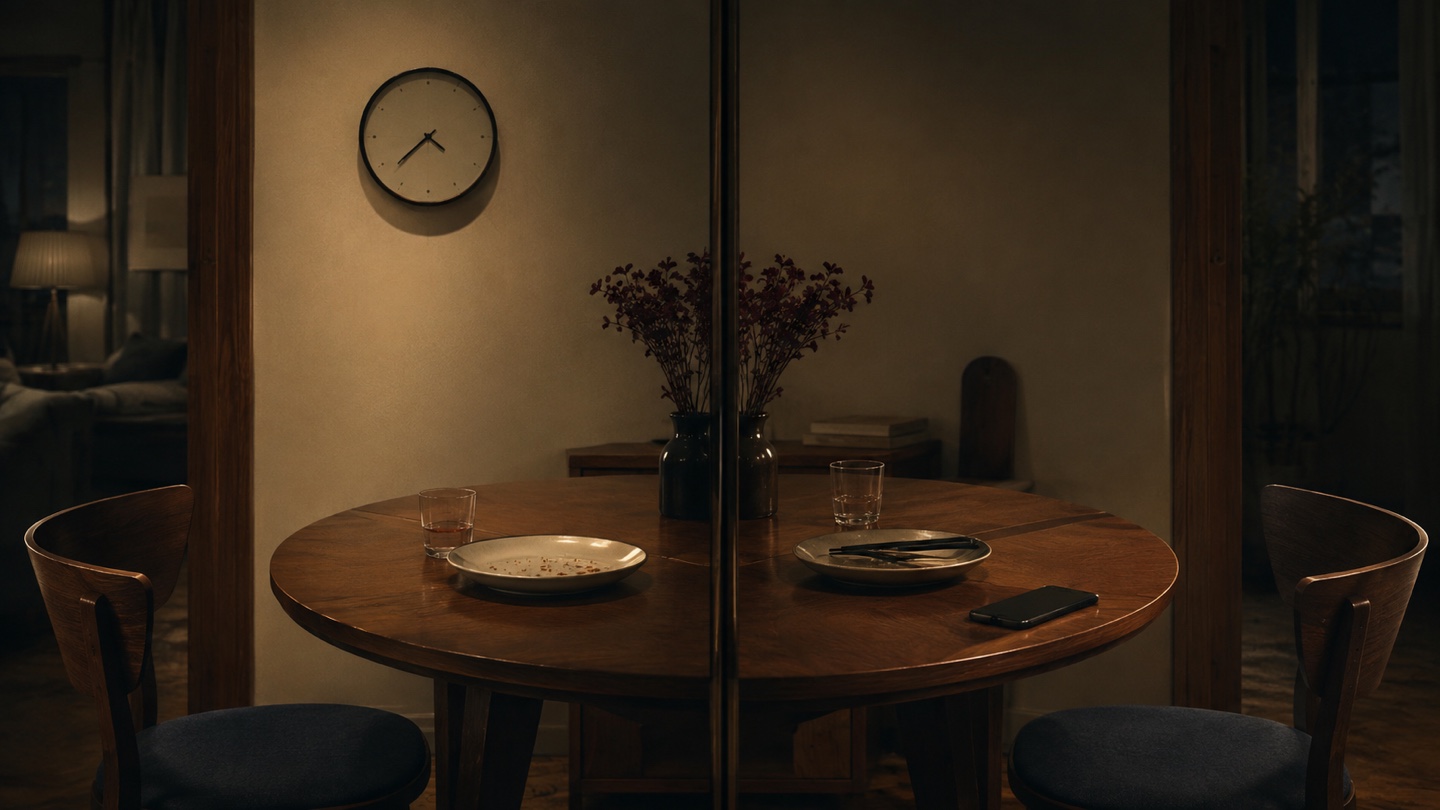
Memory is not an object sealed away after an event. Each time we return, we arrange it again. We choose where the story begins, assign causes, and omit details that no longer fit the person we are today. One remembers waiting because the waiting happened inside their body. The other remembers suffocation because that breath was trapped inside their chest.
A breakup takes more than a person. The promised future disappears, and even the shared past begins to sway between two accounts. We tell friends or strangers again and again because we want one thing confirmed: I did not love wrongly. I did not give for nothing. This ending does not prove that I was unworthy of love.
Writing can arrange a chaotic life into chapters and make cause and effect easier to see. But writing something for yourself and publishing it for everyone are not the same psychological act. The first organizes experience. The second summons witnesses.
Once a story has a beginning, a turn, an ending, and a wounded “I,” readers readily enter the narrator’s point of view. They wait, rage, and search for answers alongside the person holding the pen. Psychology calls this “narrative transportation.” Even when readers know a story is fictional, its claims can still enter their later judgments about reality.
A “purely fictional” disclaimer is a poor firewall for memory.
First-person narration naturally invites identification. “I waited.” “I was hurt.” “I only wanted an answer.” Such feelings pull readers toward the writer’s side. The silent person cannot place their own hesitation, fear, and cost inside the same piece.
Readers who take sides quickly are not always acting from malice. Often they want to protect the injured. But goodwill still needs complete facts. Someone who has been abandoned may see themselves in the person waiting. Someone who has been pursued without room to breathe understands why the other person hides. We think we are judging strangers’ love; sometimes we are defending the self we could not defend years ago.
So the central question in a one-sided letter is not simply whether it is false. A story can truthfully contain the full measure of one person’s pain and still fail to contain the full facts of two lives.
Speaking about one’s pain is legitimate. But another person’s privacy, family, and unverified inner motives do not become the narrator’s property simply because they entered a memory. A person written into someone else’s story has no opportunity to revise the sentence in real time.
When a letter leaves you angry, slow down. Separate what can be confirmed from what is the narrator’s interpretation. Leave some space for the person who has not spoken. Slowing down is not moral neutrality. It is refusing to let beautiful prose reach a verdict before the facts do.
When the spectators leave, the writer still faces a more practical question: Is this letter leading me out of the past, or keeping me inside it?
6. Healing Is Not Making the Other Person Accept Your Version
People say the best way to forget someone is to turn them into a story. Yet studies of whether expressive writing helps after heartbreak do not point in one direction.
For some people, building a coherent account can help them accept the past and imagine a future. For those prone to rumination, however, repeatedly recording every detail of the separation may prolong distress. The document grows longer while sleep becomes harder. It is not always because the lesson remains unclear. Sometimes every revision is another push against the door we did not want to reopen.
The boundary between reflection and rumination is not the number of words. It is where the words take you. Can you now separate facts from guesses, or are you still collecting evidence that the other person is bad? Is life moving forward, or does every road circle back to the same dead end?
If this anxiety is still unfolding inside a present relationship, take out a sheet of paper before sending a long chain of accusations. Write four lines:
On the first line, write what happened.
On the second, write the explanation that appeared immediately in your mind.
On the third, write what happened in your body and emotions.
On the fourth, write one concrete request the other person can answer.
Instead of “You don’t care about me,” write: “When I didn’t hear from you for three hours, the thought that came up was, ‘This relationship no longer needs me.’ My stomach tightened, and I felt scared. Next time you are busy, could you tell me roughly when we can talk?”
These four lines separate the person before you from the person who failed to return years ago. They separate fact from interpretation. They turn the impact of emotion back into an ordinary conversation two people can have.
If the relationship has ended and you are preparing to publish a long letter, leave the draft overnight. The next day, do only one thing: with two different colors, distinguish what you directly experienced from what you have inferred about the other person’s motives and character. Keep what you can verify. Label what you cannot as your interpretation, or leave the space blank.
For most people, the hardest part of heartbreak is accepting that the relationship may never receive an ending both sides recognize. The other person may never affirm your feelings, apologize for the injury, or remember the past in the way you hoped.
But your worth does not have to be wagered on that late admission.
You can admit to yourself that you loved sincerely, that you were hurt, and that fear sometimes led you to act in ways you regret. The other person’s agreement cannot determine the weight of those experiences. A crowd’s verdict cannot relive the past for you.
At the end of a relationship, regret remains. Psychology calls the repeated thought “if only” counterfactual thinking: if only I had said one sentence less; if only we had met when we were more mature. It can teach the next choice. It can also trap us inside a perfect version of events that never existed.
Goodbye does not require erasing regret. You can have loved deeply without turning back. Leaving can have been necessary, and you can still grieve that the relationship did not last. Regret proves that the relationship carried weight; it does not prove the relationship should continue. Let regret remain without turning it into a reason to reunite or a weapon for collecting what you believe you are owed.
Some people choose to believe that the person who ultimately walks beside us arrives by arrangement, and that those we miss simply completed the part of the road that was theirs. Psychology cannot prove destiny. It can understand why the belief comforts us: it allows us to accept that some parts of life cannot be recovered by trying a little harder.
If we must call it an arrangement, perhaps it is not that anyone was destined to belong to anyone else. Some people help us recognize ourselves; some teach us how to say goodbye. Destiny may soothe a loss, but it cannot replace choice. Reaching the end together can look like fate from a distance. Inside ordinary days, it is still made of two people choosing, again and again, to respond, repair, and return.

Psychology cannot hand us a clean ledger of right and wrong. Perhaps all it can offer is one second of pause before the familiar reaction begins. Yet inside that second, the old response is no longer the only possible road.
The next time your phone stays dark, do not send the fifth message yet. Set it back on the table and wait until your breathing slows. Let silence be only silence for a moment. Then ask softly: Is this merely one unanswered message, or has the child who once waited alone returned again?
The phone on the table remains quiet. It does not light up. This time, you stop watching the screen. You stand and pour yourself a glass of warm water.

References and Further Reading
[1] Ross, M., & Sicoly, F. (1979). “Egocentric biases in availability and attribution.” Journal of Personality and Social Psychology, 37(3), 322–336.
[2] Green, M. C., & Brock, T. C. (2000). “The role of transportation in the persuasiveness of public narratives.” Journal of Personality and Social Psychology, 79(5), 701–721. DOI.
[3] Marsh, E. J., Meade, M. L., & Roediger, H. L. (2003). “Learning facts from fiction.” Journal of Memory and Language, 49(4), 519–536. DOI.
[4] Feinberg, M., Willer, R., Stellar, J., & Keltner, D. (2012). “The virtues of gossip: Reputational information sharing as prosocial behavior.” Journal of Personality and Social Psychology, 102(5), 1015–1030. DOI.
[5] Bowlby, J. (1982). Attachment and Loss, Vol. 1: Attachment (2nd ed.). Basic Books.
[6] Hazan, C., & Shaver, P. R. (1987). “Romantic love conceptualized as an attachment process.” Journal of Personality and Social Psychology, 52(3), 511–524. DOI.
[7] Simpson, J. A., Collins, W. A., & Salvatore, J. E. (2011). “The impact of early interpersonal experience on adult romantic relationship functioning.” Current Directions in Psychological Science, 20(6), 355–359. DOI.
[8] Fraley, R. C., & Heffernan, M. E. (2013). “Attachment and parental divorce: A test of the diffusion and sensitive period hypotheses.” Personality and Social Psychology Bulletin, 39(9), 1199–1213. PubMed.
[9] Crowell, J. A., Treboux, D., & Brockmeyer, S. (2009). “Parental divorce and adult children’s attachment representations and marital status.” Attachment & Human Development, 11(1), 87–101. PubMed.
[10] Wilkins, C. L., et al. (2021). “Parent-child relationship quality in the family of origin and later romantic relationship functioning: A systematic review.” Family Process. PubMed.
[11] Feldman, S., & Downey, G. (1994). “Rejection sensitivity as a mediator of the impact of childhood exposure to family violence on adult attachment behavior.” Development and Psychopathology, 6(1), 231–247. PubMed.
[12] Downey, G., & Feldman, S. I. (1996). “Implications of rejection sensitivity for intimate relationships.” Journal of Personality and Social Psychology, 70(6), 1327–1343. PubMed.
[13] Murray, S. L., Holmes, J. G., & Griffin, D. W. (1996). “The benefits of positive illusions: Idealization and the construction of satisfaction in close relationships.” Journal of Personality and Social Psychology, 70(1), 79–98. DOI.
[14] Murray, S. L., Holmes, J. G., & Griffin, D. W. (1996). “The self-fulfilling nature of positive illusions in romantic relationships.” Journal of Personality and Social Psychology, 71(6), 1155–1180. PubMed.
[15] Aron, E. N., & Aron, A. (1996). “Love and expansion of the self: The state of the model.” Personal Relationships, 3(1), 45–58. DOI.
[16] Rusbult, C. E. (1980). “Commitment and satisfaction in romantic associations: A test of the investment model.” Journal of Experimental Social Psychology, 16(2), 172–186. DOI.
[17] Le, B., & Agnew, C. R. (2003). “Commitment and its theorized determinants: A meta-analysis of the Investment Model.” Personal Relationships, 10(1), 37–57. DOI.
[18] Arkes, H. R., & Blumer, C. (1985). “The psychology of sunk cost.” Organizational Behavior and Human Decision Processes, 35(1), 124–140. DOI.
[19] Sbarra, D. A., Boals, A., Mason, A. E., Larson, G. M., & Mehl, M. R. (2013). “Expressive writing can impede emotional recovery following marital separation.” Clinical Psychological Science, 1(2), 120–134. DOI.
[20] Czarnecka, J. Z., & Trzebiński, J. (2025). “The effects of narrative framing of own broken love on understanding the past and imagining the future in close relationships.” PLOS ONE, 20(11), e0334973. DOI.
[21] Haimson, O. L., Andalibi, N., De Choudhury, M., & Hayes, G. R. (2018). “Relationship breakup disclosures and media ideologies on Facebook.” New Media & Society, 20(5), 1931–1952. DOI.
[22] Petronio, S. (2002). Boundaries of Privacy: Dialectics of Disclosure. State University of New York Press.
[23] Fraley, R. C., Gillath, O., & Deboeck, P. R. (2021). “Do life events lead to enduring changes in adult attachment styles?” Journal of Personality and Social Psychology, 120(6), 1567–1606. PubMed.
[24] Mikulincer, M., & Shaver, P. R. (2020). “Enhancing the ‘broaden and build’ cycle of attachment security in adulthood.” International Journal of Environmental Research and Public Health, 17(6), 2054. DOI.
[25] Christensen, A., & Heavey, C. L. (1990). “Gender and social structure in the demand/withdraw pattern of marital conflict.” Journal of Personality and Social Psychology, 59(1), 73–81. DOI.
[26] Jack, D. C. (1991). Silencing the Self: Women and Depression. Harvard University Press.
[27] Pāli Canon: Aṅguttara Nikāya 6.63 on intention and karma; Aṅguttara Nikāya 3.61 against attributing all pleasure and pain to past karma; Saṃyutta Nikāya 12.20 on dependent conditions; and Saṃyutta Nikāya 56.11 on suffering that includes separation from what is loved and not obtaining what is desired.
[28] Kishimi, I., & Koga, F. The Courage to Be Disliked: How to Free Yourself, Change Your Life and Achieve Real Happiness.
[29] van Scheppingen, M. A., Olaru, G., & Leopold, T. (2025). “Personality trait similarity in recently cohabiting couples: Partner choice, convergence, or selective breakup?” Journal of Personality and Social Psychology, 128(4), 887–904. DOI.
[30] Arránz Becker, O. (2013). “Effects of similarity of life goals, values, and personality on relationship satisfaction and stability: Findings from a two-wave panel study.” Personal Relationships, 20(3), 443–461. DOI.
[31] Rossignac-Milon, M., Bolger, N., Zee, K. S., Boothby, E. J., & Higgins, E. T. (2021). “Merged minds: Generalized shared reality in dyadic relationships.” Journal of Personality and Social Psychology, 120(4), 882–911. DOI.
[32] Markey, P. M., & Markey, C. N. (2007). “Romantic ideals, romantic obtainment, and relationship experiences: The complementarity of interpersonal traits among romantic partners.” Journal of Social and Personal Relationships, 24(4), 517–533. DOI.
[33] Roese, N. J. (1994). “The functional basis of counterfactual thinking.” Journal of Personality and Social Psychology, 66(5), 805–818. DOI.