Can We Really Change Our Fate?
Physics cannot choose for us. But it can dismantle several illusions we hold about destiny.
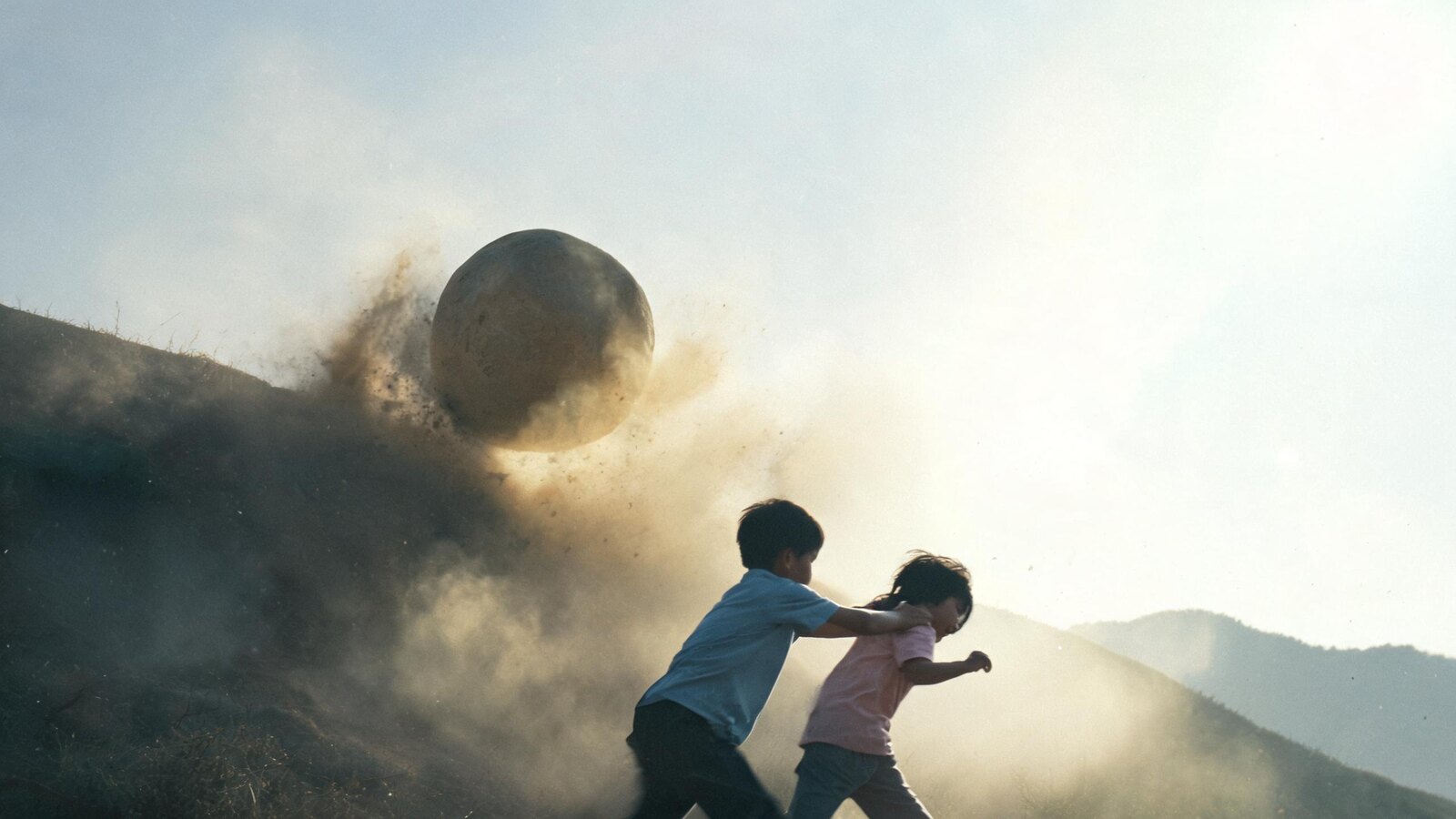
When he was six, Japanese boy Tsuruhiko Kiuchi went wading in the Chikuma River with his two sisters. He was walking behind the sister who was one year older when a boulder suddenly broke loose from the hillside. Someone behind him shouted, “Watch out!” Instinctively, he shoved his sister aside. Both children escaped the falling rock. But when he turned around, no one was there. For years, he had no idea where the warning had come from.
Much later, after a near-death experience during a severe illness, Kiuchi claimed that his consciousness had returned to that childhood afternoon. As he watched the boulder roll toward his sister once again, he cried out, “Watch out!” Only then, he said, did he understand: the voice he had heard at six was his own, calling from adulthood.
This is personal testimony, not scientific evidence that time travel has occurred. Yet the question it leaves behind is hard to forget. Without that future warning, would the boy and his sister have escaped the boulder? And if the boy had not survived to grow up, where could the future warning have come from?
The first person to put a closely related problem into the equations of physics was Kurt Gödel. A story can simply let your future self speak. An equation must answer a harder question: how can the past and future coexist without making history contradict itself?
1. A Birthday Gift That Troubled Einstein
Princeton, spring 1949. Albert Einstein was turning seventy. His friends prepared a collection of essays in his honor. Gödel offered no conventional tribute. Instead, from Einstein’s own field equations, he derived a universe in which time could curve back upon itself.
Gödel was one of the twentieth century’s greatest logicians. In 1931, at the age of twenty-five, he proved that any sufficiently powerful and consistent formal system contains truths that cannot be proved from within that system. Mathematics did not collapse. It simply saw its own boundary with unprecedented clarity.
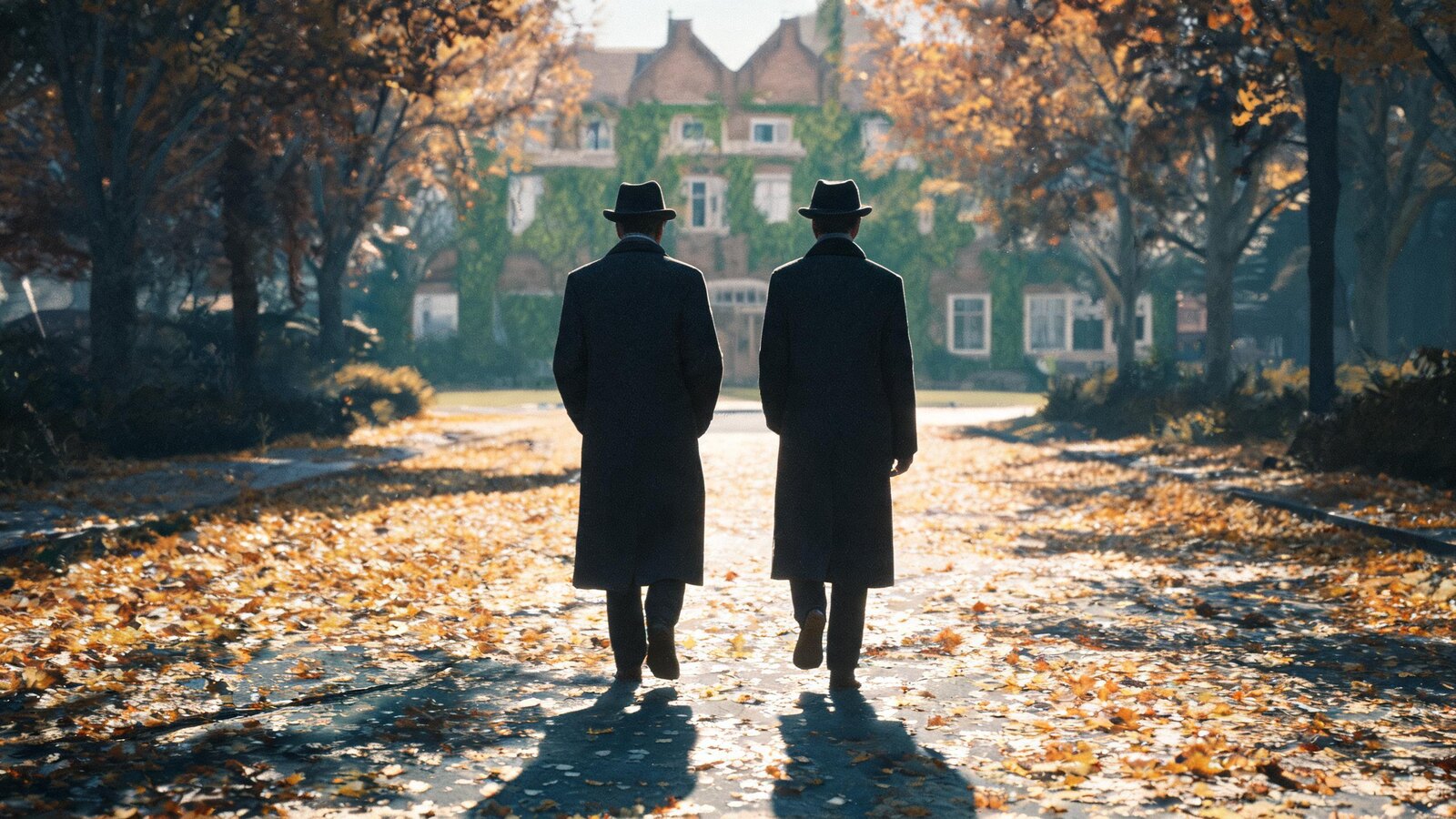
Gödel later moved to the Institute for Advanced Study in Princeton and became Einstein’s regular walking companion. In his later years, Einstein reportedly said that he still went to the Institute largely for the privilege of walking home with Gödel. The man who understood the limits of logic better than almost anyone eventually carried the question to the limits of spacetime.
Gödel had found an exact solution to Einstein’s field equations: a universe rotating as a whole. In that universe, the distribution of matter and the geometry of spacetime together permit closed timelike curves. An observer travelling along such a curve would still feel their own clock ticking forward, second by second. Local cause and effect would not disappear. The strange part is that the entire worldline would eventually return to an earlier point in spacetime.
Imagine a straight line drawn on a sheet of paper. While the paper lies flat, the line cannot return to its starting point. Roll the geometry around, however, and a line that always moves forward may eventually bite its own tail. The analogy only helps us picture the idea. What bends in Gödel’s solution is four-dimensional spacetime, not a sheet of paper hidden somewhere outside the universe.
So far, observations do not support the idea that we live in a Gödel-type universe rotating as a whole. His solution is therefore not a portrait of our actual cosmos. But it exposed a fissure in general relativity: the equations do not automatically forbid closed paths through time. Mathematical permission is not physical existence. Still, from that moment on, “Can we return to the past?” belonged on a physicist’s blackboard, not only in a novelist’s notebook.
The deeper implication was not merely that time travel might be possible. Relativity had already abolished a single absolute “now” shared by the whole universe. Gödel went further: some spacetimes may not allow every event to be arranged in one globally consistent order. Time as we experience it remains perfectly real in everyday life, yet it may not be the universe’s most fundamental or universal skeleton. Einstein’s unease came from watching his theory travel farther than his intuition was prepared to follow.
This is where our previous essay, Does Time Really Exist?, leaves us: the Wheeler–DeWitt equation contains no ordinary time variable, while the flow we experience may emerge from relations and changes in entropy. We will not retrace that argument here. Beginning with Gödel, we will ask a different question: if spacetime can be described as a whole, is there still room for choice?
2. The Equations Leave the Door Ajar
In 1985, while writing the novel Contact, Carl Sagan encountered a technical problem. How could his characters reach Vega, twenty-six light-years away, within a plausible span of time? He sent the question to Caltech physicist Kip Thorne. Rather than send the characters through an ordinary black hole, Thorne seriously calculated what sort of spacetime geometry a traversable wormhole would require.
In 1988, Michael Morris and Thorne published a paper on a wormhole that a traveller could, in principle, cross without being torn apart by tidal forces. Keeping its throat open would require an extraordinarily unusual distribution of stress and energy, often described as “exotic matter” or negative energy density. Quantum field theory permits local negative-energy effects, but humanity has never obtained anything capable of supporting a large, stable wormhole. These facts cannot be collapsed into the comforting phrase “a material we simply have not discovered yet.”
Now grant the enormous premise that a traversable wormhole exists and can be kept stable. If one mouth were accelerated to high speed and then brought back, time dilation could leave the two mouths’ clocks out of sync. Passing through the wormhole might then allow a traveller to emerge, in the surrounding spacetime, before the moment of departure. This is not an automatic feature of wormholes. It is the consequence of a chain of assumptions, none of which has been realised.
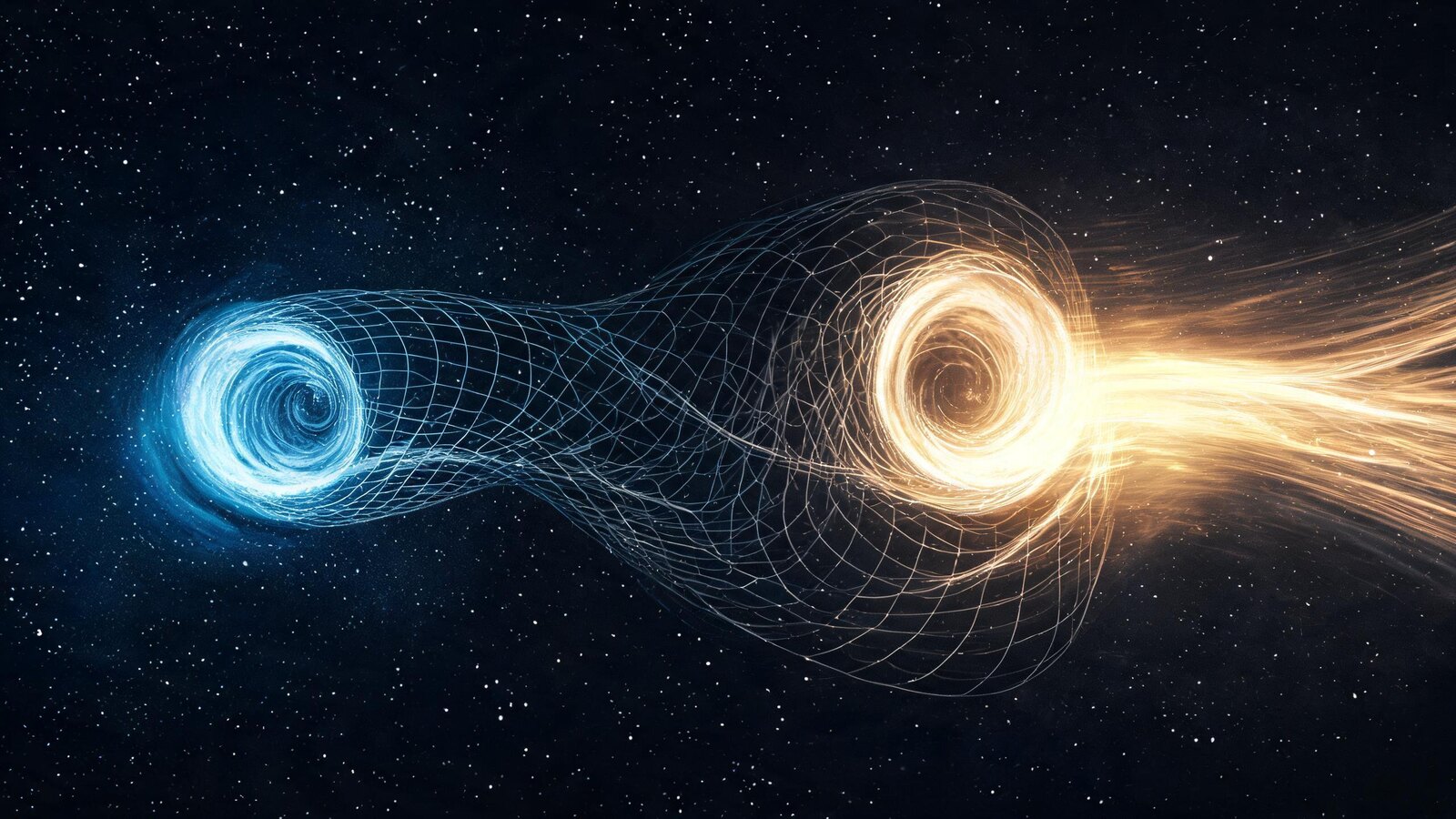
That same year, Morris, Thorne and Ulvi Yurtsever published the idea in Physical Review Letters under a title more direct than many science-fiction novels: “Wormholes, Time Machines, and the Weak Energy Condition.” The mathematics left the door ajar, but energy conditions, quantum effects and engineering feasibility were all waiting on the other side. And even if we someday crossed that threshold, a harder problem would appear immediately: how could a visitor to the past avoid contradicting their own history?
3. Three Ways Out of the Grandfather Paradox
Over the past several decades, physics has offered three broad answers. They are not three experimentally established laws of nature, but three theoretical strategies for handling contradiction.
The first: history must be self-consistent
In 1990, John Friedman, Igor Novikov, Kip Thorne and their collaborators studied classical systems containing closed timelike curves. They sent a billiard ball through a wormhole, allowed it to return and collide with its earlier self, and calculated which trajectories could satisfy the equations. An initially imagined contradiction would not produce a self-consistent solution. A physically admissible trajectory had to fit together with itself.
One possible trajectory works like this: the returning ball nudges its younger self only slightly, so the younger ball still enters the wormhole and later returns to deliver that same nudge. If the collision made the earlier ball miss the wormhole entirely, no later ball could emerge to cause the collision. Self-consistency means that the past and future must close into one story without cancelling each other.
The constraint applies to the history as a whole, not to what a person feels at a particular moment. A traveller who returns to the past might still hesitate, aim and pull the trigger, experiencing each act as a choice. But when every event is placed back into the same spacetime picture, the events cannot add up to a logical contradiction. There is room here to debate free will. There is no justification for translating “self-consistent” into “someone else made the decision for you.”
The second: a quantum system finds a fixed point
In 1991, David Deutsch proposed a quantum model of closed timelike curves that imposes a consistency condition on quantum states. Popular accounts often turn it into “if you go back, you enter another branch.” That is one interpretation of the mathematical structure, not proof that someone could kill a grandfather in another universe.
In 2014, a team at the University of Queensland simulated the corresponding quantum-information process with photons. The experiment tested how the model handles information. It came nowhere close to sending a particle back to yesterday.
The third: nature prevents a time machine from forming
In 1992, Stephen Hawking proposed the chronology protection conjecture. Quantum fields near the boundary where a time machine would form might generate a backreaction strong enough to prevent closed timelike curves from becoming stable. It remains an important theoretical judgment, but it is still a conjecture, not a prohibition nature has been observed enforcing.
It seems that there is a Chronology Protection Agency which prevents the appearance of closed timelike curves and so makes the universe safe for historians.
— Stephen Hawking, “Chronology Protection Conjecture”
All three approaches confront the same problem: how can history avoid contradicting itself? The phrase “history must be self-consistent” may sound like the old idea that an unseen fate has arranged everything in advance. But consistency requires only that a history not refute itself. It does not imply that anyone wrote the script for us. The history became what it is partly through every hesitation, judgment, retreat and act of persistence within it.
Interstellar transformed that austere principle into the story of a daughter waiting for her father to come home.
4. Interstellar: A Father Who Could Not Rewrite His Daughter’s Childhood
In the film, the paradox enters through a child’s bedroom. Young Murph believes that a “ghost” lives behind her bookcase. Books fall. Dust arranges itself into coordinates. Her father, Cooper, follows those coordinates and leaves Earth. Years later, after falling into a black hole, he discovers that he himself was the figure sending signals through the shelves.

This is not the grandfather paradox but a bootstrap paradox, also called an ontological paradox. The coordinates pass from the future Cooper to the past Cooper. Past Cooper therefore begins the journey that turns him into the man who transmits the coordinates. Information or an object remains trapped in a closed causal loop, with no first origin that can be traced outside it. That missing origin is precisely what makes the loop so strange.
The film enlarges the same structure. The wormhole near Saturn was placed there by future humanity, yet future humanity exists only because the wormhole was there. There was no first morning on which someone suddenly began saving humankind. Saving and being saved form one history together.
But Cooper does not receive an eraser for his life. He cannot undo the parting or return the childhood his daughter lost. With his final chance, he can only place the information she needs inside an old wristwatch.
Murph waits a lifetime before understanding that the falling books, the patterns in the dust and the trembling second hand were all her father’s desperate attempts to find a way home from the far side of time.
Perhaps you have known a day like that. A phone call you did not answer. A door slammed during an argument. The moment someone truly turned away while you still believed there would always be another chance. Years later, you understand that some doors close on an entire life. When we dream of returning to the past, we may not truly expect to change that day. We may only want to step back into the room of memory, hold the self who does not yet know what is about to be lost, and say: you will hurt for a long time, but do not leave the rest of your life waiting outside this door.
If one history has no room for another ending, it is natural to look toward a wider picture: perhaps every unrealised possibility continues to grow on another branch.
5. Does the Tree of Fate Branch With Every Choice?
If history has only one line, it can feel suffocating. So we prefer to imagine fate as a tree that never stops growing. Perhaps, in another parallel world, another version of us is continuing the stories we abandoned. They moved to the city we never reached, spoke the love we left unspoken, or kept beside them the person we could not keep. The thought is moving because it seems to preserve, for every regret, one possibility in which nothing was lost.
But this refuge for regret is not the same thing as the many-worlds interpretation of quantum mechanics.
Many-worlds is one interpretation of quantum theory. It says that measurement does not mysteriously reduce the quantum state to a single outcome. The possible outcomes continue within the total wavefunction; as a system interacts with its environment and decoheres, different branches cease to interfere with one another. The branching comes from quantum processes. The universe does not wait at a crossroads for a human being to announce “A” or “B.”
Human brains and human decisions are, of course, part of the physical world and would be correlated with those branches. But we have no evidence that a thought can deliberately select or create a universe. Max Tegmark’s several levels of “parallel universes” range from cosmological models to metaphysical proposals, and their evidential status differs accordingly. None can be reduced to the claim that “somewhere, everything happens.”
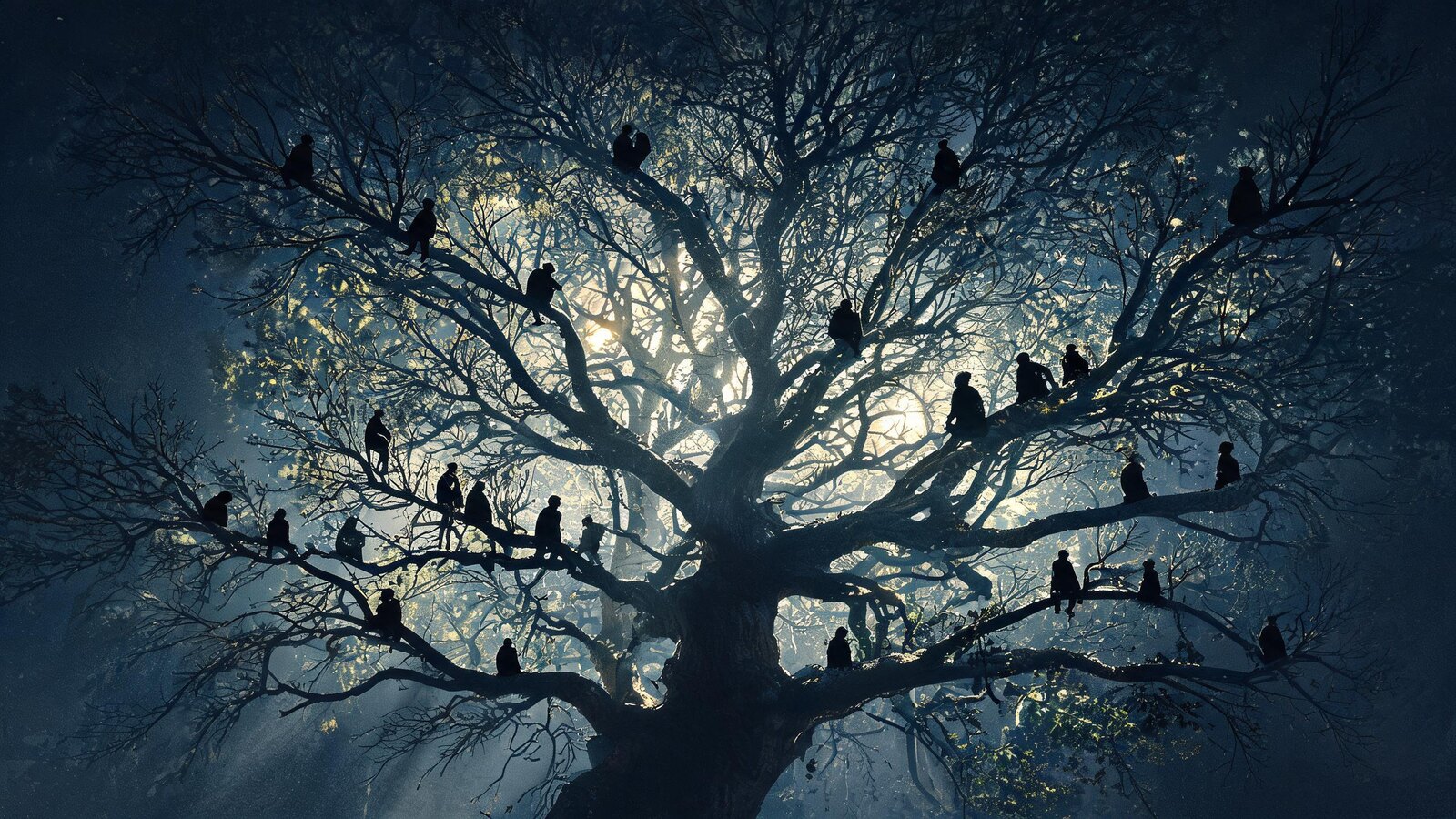
Even if another version of you exists on another branch, they cannot send their happy ending back here. A confession spoken elsewhere cannot undo your silence. An error avoided elsewhere cannot repair the relationship in front of you.
Yet the image of a life as a tree remains meaningful. We do not choose the soil in which it first takes root. We cannot erase the bends left in its trunk by family, history or the habits of temperament. But from today onward, each act of approaching or leaving, learning or abandoning, persisting or yielding changes the direction of the next branch.
Fate may have written the opening. It may even make some roads smoother and others steep. It has not walked the rest of the life for us.
The self in another world can preserve a possibility for the imagination; it cannot live this world for us. Only the next step beneath our feet can turn one possibility into the life we actually inhabit. And sometimes a sentence about the future changes that step before we have even begun.
6. How a Prophecy Enters a Life
What most unsettles people about fortune-telling is rarely a vague promise that “things will improve.” It is the prediction precise enough to name a year, a relative, a marriage or a turning point. The more definite it sounds, the less fate resembles a fog. It begins to look like a printed decree, waiting for someone to open the book to the correct page.
A prediction that seems to know details of a stranger’s past easily persuades us that it must also see the future. But those are two different claims. Before accepting the second, we should ask whether the prediction was written down in full before the events, whether its failures were preserved beside its hits, and whether independent readers using the same rules would reach the same result. Only advance registration, blind checking and a complete record of success and failure can turn an astonishing anecdote into evidence that others can evaluate.
Another popular explanation says that fortune-telling changes destiny because “observation collapses the wavefunction.” A person’s fate supposedly begins as a quantum superposition and, once read, is forced by observation into one outcome. It is a beautiful metaphor with the mechanism reversed.
Measurement in quantum mechanics is a physical interaction between a system and an apparatus or environment. It does not require a conscious observer to see the result, much less believe it. For a prophecy to influence a person, by contrast, the person must hear it, remember it and begin to live in its shadow.
Behind the mistaken quantum language, however, lies a real and powerful psychological and social mechanism. In 1948, sociologist Robert Merton named it the “self-fulfilling prophecy”: a judgment that is initially false changes people’s behavior, and their behavior then helps make the judgment come true. A bank may be solvent, yet a rumor of collapse can send every depositor to the counter at once and bring about the very failure the rumor predicted.
Karl Popper used the story of Oedipus to illustrate the same loop. Because the father believes that his son will kill him and marry his mother, he abandons the infant. That attempt to escape the prophecy ensures that the adult Oedipus will not recognize his birth parents—and so walks him into the oracle’s prediction. The prophecy did not report a fact from the future. It entered the present and became one of the causes that made the future.

Rosenthal and Jacobson’s 1968 classroom study likewise connected teachers’ expectations with students’ later performance. Both the original study and its broader interpretation remain contested; later evidence suggests that the effects are usually smaller than popular accounts imply and depend heavily on context. The careful conclusion is not “believe and it will happen,” but that expectations may alter some outcomes through attention, feedback, access to opportunity and persistence.
“This is as far as you will ever go.” “You are not made for this.” “That child will never amount to anything.” A sentence spoken by someone important can take up residence inside a person for years. When an opportunity appears, they do not reach for it. When a relationship begins to fracture, they assume they will be abandoned and withdraw first. A prophecy’s greatest power may lie not in whether it was accurate, but in whether we allowed it to join the chain of causes that followed.
Yuan Huang, the Ming-dynasty scholar whose story became Liaofan’s Four Lessons, spent twenty years confined by an uncannily specific prediction. A fortune-teller named Kong told him how he would rank in examinations, how much salary he would receive, how long he would live and even that he would die without a son. Later events appeared to confirm one prediction after another. Yuan wrote that for twenty years he “gave rise to no wandering thought.” It sounds peaceful. It also sounds like a man who stopped asking life to contain any new possibility, because he had surrendered even the act of expecting one.
After meeting the Chan master Yungu, Yuan began recording his good and harmful deeds, changing his conduct and doing things his earlier self would never have done. Gradually, his life diverged from the old forecast.
Destiny is made by oneself; good fortune is sought by oneself.
— Master Yungu, as recorded in Liaofan’s Four Lessons
Liaofan’s Four Lessons is a work of family instruction and religious moral cultivation, not modern experimental evidence. Its enduring power does not lie in promising that whatever we think will appear. It reminds Yuan that although he cannot command the world, he can change his choices—and changed choices can carry a life elsewhere. Perhaps Kong had predicted the life most likely to unfold if family background, habits of character and historical circumstances all remained unchanged. Yungu did not move Yuan into another universe. He allowed a man frozen by prediction to participate in his own life again.
One who understands fate does not stand beneath a wall that is about to fall.
— Mencius, “Jinxin I”
To understand fate is not to calculate the date on which the wall will crush you. It is to see the wall leaning and choose another road. A good forecast is a risk map that helps us prepare. A bad one is a sentence that demands obedience.
Prophecy enters the world through belief. Feng shui raises a different question: beyond what we believe, can the environment we inhabit quietly alter the road we take?
7. What Is Really at Work in Ni Kuang’s Feng Shui?
Ni Kuang’s 1970 Wisely story Feng Shui is built around a brilliant premise. The tycoon Tao Qiquan believes that the fifty years of good fortune conferred by his family’s “whale-swallowing” ancestral grave are about to expire. He asks Wisely to risk his life relocating it. Wisely does not believe in feng shui, yet he goes—because his own disbelief is beside the point. Tao controls enormous capital, and Tao believes. If that confidence collapses, his decisions will have real consequences.
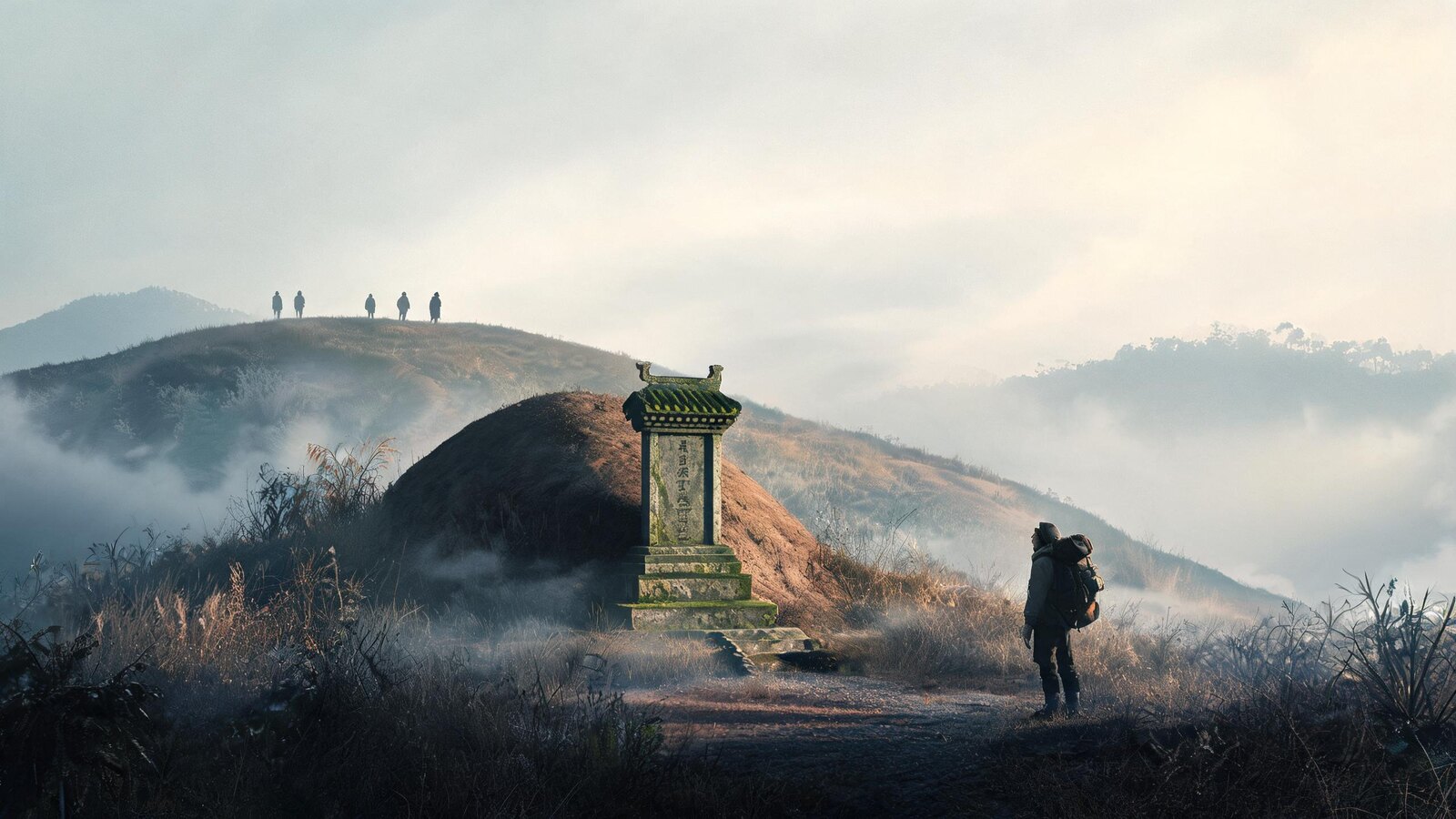
Whether the grave possesses a mysterious power is almost secondary. What clearly acts in the story is Tao’s belief, which begins to alter his judgment and decisions. The belief does not rewrite the world at a distance. It enters reality through fear and action. The physical environment—light, ventilation and noise—may affect a life through another route altogether.
Feng shui speaks of qi, harmful forces and the fortune of ancestral graves. It also considers orientation, daylight, airflow, noise, circulation and view. The first category has not produced repeatable scientific evidence. Factors in the second can genuinely affect sleep, stress, attention and behavior. Ancient observations may overlap with some environmental effects, but that overlap cannot validate the entire system of feng shui in reverse.
In 1984, environmental psychologist Roger Ulrich examined records of gallbladder-surgery patients at a hospital from 1972 to 1981, matching them on several characteristics. Across twenty-three pairs, patients whose windows faced trees stayed an average of 7.96 days, compared with 8.70 days for patients facing a brick wall. The tree-view group also required fewer doses of strong pain medication and received fewer negative notes from nurses.

The study included only forty-six patients. It was retrospective and matched, not a randomized controlled trial, so it cannot bear the claim that “science has proved feng shui.” It points to a more ordinary pathway. A window does not decide whether a patient recovers, but day after day it may influence mood, sleep and willingness to move. Those small changes enter treatment and behavior and may eventually leave a statistical trace.
Much of what we call “changing fate” arrives without thunder or an answer from the cosmos. It may mean moving the bed into the morning light, leaving a relationship that steadily drains you, or entering a place where you are willing to read ten pages each day. Change the conditions a little at a time, and some futures become a little easier to reach.
But if an environment changes a life through the body and behavior, can a thought bypass those intermediate steps and make the world respond directly? The Secret pushes the argument to that point.
8. The Secret Places an Order With the Universe
The Secret goes considerably further than saying that attitude influences action. It claims that thought can bypass action and directly attract external events. Once a claim goes that far, it must answer a practical question: when different people follow the same method, can the result be reproduced reliably? The book does not provide such evidence.

The law of attraction is difficult to expose to a possible counterexample. If the desired result appears, the law is said to have worked. If it does not, the believer is told that their faith was insufficient or their “frequency” was wrong. A claim that cannot be falsified has not thereby been proved false, but neither has it been established. It means that empirical testing cannot currently decide whether the claim is true. What we can examine is how the explanation affects those who accept it.
Psychologist Gabriele Oettingen’s research tested one observable part of this process, not whether the universe answers thoughts. Positive expectations are judgments, grounded in reality, that a goal is likely to be achieved. Positive fantasies immerse a person in an image of the goal as though it had already been achieved. In a 2002 study with Doris Mayer, Oettingen found that higher expectations tended to predict better outcomes, while idealized fantasies alone were associated with worse ones.
Later experiments suggested that immersive positive fantasies can reduce immediate physiological activation and effort. There is no need to claim that “the brain cannot tell fantasy from reality.” A more careful explanation is that tasting the feeling of completion in advance may temporarily reduce mobilisation. We enjoy the reward before doing the work, and then walk a few steps less.
Oettingen’s mental contrasting and Peter Gollwitzer’s implementation intentions turn fantasy into an actionable path. Clarify the wish and the desired outcome, identify the internal obstacle, and then write an if–then plan: “If X occurs, I will do Y.” The point is not to ban negative thoughts. It is to place the obstacle inside the plan. Reality is not driven out by positive thinking; it becomes a foothold for action.
Barbara Ehrenreich, in Bright-sided, criticized a more brutal side of compulsory optimism. Patients are told to stay positive, as though a worsening illness revealed a failure of attitude. When a belief system claims credit for success and puts the victim on trial for failure, its problem is no longer merely whether it “works.”
The Secret says that thought itself can summon reality. That moves the question beyond psychology. Can human intention directly alter matter without bodily action? For twenty-eight years, a Princeton laboratory seriously tried to find out.
9. Can a Thought Move Matter?
In 1979, Robert Jahn, then dean of Princeton’s School of Engineering and Applied Science, founded the Princeton Engineering Anomalies Research laboratory, or PEAR. The laboratory studied whether human intention could make random-number generators depart from randomness. The programme ran for twenty-eight years, accumulated a very large number of trials and reported extremely small deviations.

In 2006, Holger Bösch and colleagues conducted a meta-analysis of related random-number-generator experiments. The overall effect was tiny, results varied substantially between studies, and the findings were related to sample size; the authors judged publication bias to be a sufficient possible explanation. The accurate conclusion is not that science has proved intention can never matter at a distance. It is that the field has failed to produce stable, repeatable and convincing evidence that it does. PEAR closed in 2007.
That history is worth preserving in full. An extraordinary claim was treated seriously and measured repeatedly, yet it did not clear the threshold of reliability. Scientific respect means neither believing in advance nor mocking in advance. It means giving a claim a test it is capable of failing.
Nor can “not established” be exchanged for “science cannot explain it, therefore a supernatural answer is equally valid.” When we do not know, the evidence ledger remains empty. It does not award equal weight to every answer. Admitting the unknown requires us to leave the blank space open rather than filling it at once.
In ordinary life, there is no mystery in the way thought changes the world. You decide to raise your hand, and the arm moves. You decide to speak, and a sentence gains the chance to reach another person and alter their next step. Beliefs guide what we notice and how we choose; choices then enter relationships, institutions and material life.
We must therefore separate two claims. There is no reliable evidence that intention alone can reach across space and nudge a random-number generator. But when a thought becomes action repeated day after day, it changes bodies, relationships and circumstances. The first is an unestablished paranormal claim. The second happens constantly.
Even so, effort does not oblige life to return the result we desire. Here the difference between making a wish and making a vow becomes decisive: one waits for the world to deliver; the other decides how one will continue.
10. A Vow Is Not an Order Placed With the Universe
“When you make a great vow, the whole universe comes to your aid” sounds a great deal like the law of attraction. Both begin from a state that does not yet exist, and both assume that direction can change a life. The real difference is not how noble the desire sounds. It is who is expected to act.
An order demands a result from the world. A vow commits oneself to sustained action in a direction. Self-interest is not shameful. Wanting health, financial freedom or a better life for one’s family is legitimate. But if helping others is merely a hidden transaction designed to secure a reward, it remains an order. Elevated language does not change its structure.
First, look at the subject of the sentence
“I want a car” describes a state in which “I possess something.” The Four Great Vows in Buddhism instead place the emphasis on continuing action:
Sentient beings are numberless; I vow to liberate them. Delusions are inexhaustible; I vow to end them. Dharma gates are boundless; I vow to enter them. The Buddha Way is unsurpassable; I vow to realise it.
— The Four Great Vows
The third chapter of the Diamond Sutra pushes the subject farther from the centre: innumerable beings are led to liberation, yet “in reality no being has been led to liberation.” Action continues, but its merit need not flow back into an expanding self. If a vow exists only to prove one’s greatness, the “I” never left the stage.

Then, ask how it faces time and failure
An order comes with a delivery date; when the result is late, each passing day feels like a debt. A vow is more like a compass. It cannot promise when we will arrive. It tells us where the next step points. It does not abolish goals. It refuses to let one future outcome monopolize the meaning of the present.
In some accounts of the law of attraction, failure returns as an accusation: “You did not believe strongly enough.” A vow does not close the circle in this way. “Sentient beings are numberless” acknowledges from the beginning that the work cannot be completed. What remains undone today can be continued tomorrow. A vow does not guarantee the world’s cooperation. It asks the person acting not to outsource their direction to the world.
A familiar Chinese saying goes, “What is yours will come; what is not, do not force.” After a person has done all they can, those words can be merciful. Outcomes depend on many conditions, and every loss need not be translated into “I was not good enough.” But spoken before action begins, “do not force” becomes a door closed in advance. That is not wisdom. It is a present probability disguised as a final verdict.
That is why the order of another saying matters: do all that is humanly possible, then accept what lies beyond your control. Before acting, do not use fate to cancel effort. After doing your part, do not use the outcome to keep punishing yourself.
When the monk Xuanzang crossed the Moheyan Desert on his journey west, he went for days without water. What sustained him was a vow, not an order. His biography records the severity of his resolve:
I would rather die travelling west than return east alive.
— Xuanzang, Biography of the Tripiṭaka Master of the Great Ci’en Monastery

This was not a prediction of success. It was a choice of direction. Xuanzang did not know whether he would arrive. He knew only that while one more step remained possible, he would take it westward. A vow is strongest not when it believes an outcome is guaranteed, but when the outcome remains unknown and a person has already decided how to walk.
Here is a simple test. Write your deepest wish as a sentence, then remove the word “I.” If the sentence collapses, it is probably a desire or an order. If a clear direction for action remains, it is closer to a vow. There is nothing shameful about an order. We simply should not expect it to carry us through years that offer no receipt.
As for the famous line “Once one truly commits, Providence moves too,” it was not written by Goethe. W. H. Murray included a related passage in his 1951 book The Scottish Himalayan Expedition, followed by a free rendering from Goethe’s Faust by John Anster. Over time, both layers were attributed to Goethe. Longevity does not turn a misquotation into an original text.
A vow may still change at least three observable things: it widens the radius of action, increases our tolerance for necessary risk and changes the way other people respond to us. These shifts can reshape opportunity without supposing that the universe understood the request. What feels like “the world came to help” is often the accumulation of ordinary causes over a long time.
We must also remember survivorship bias. Those whose vows end in achievement become visible; those who made the same commitment and did not arrive often disappear from the story. The deeper value of a vow is the sense of mission it can sustain without being wholly dependent on success. Even without applause—and even if the destination is never reached—a person can still know why they rose today. The next step is no longer empty. Results may change; a sense of purpose can join scattered days into a road.
Nor is a vow nobler simply because it demands more sacrifice. Research by Elizabeth Dunn, Lara Aknin and Michael Norton links spending on others with greater subjective happiness. Yet Adam Grant’s discussion of “givers” also shows that people who give without boundaries can end up at the bottom of the performance distribution. If a vow demands the destruction of one’s health, the exhaustion of one’s family or the surrender of judgment, it has ceased to be a direction and become self-erasure. Sustained action needs compassion, and it needs boundaries.
A vow and a desire are therefore not opposite poles of good and evil. Desire tells us what is missing. A goal converts the absence into a task. A vow answers a longer question: if this particular task fails, what direction remains worth following? All three can coexist. The danger is not wanting a result. It is mortgaging one’s entire worth to a single result.
A vow has power because it passes through time. An unremarkable act today may, many years from now, become the reason your future self did not fall.
11. What Can You Leave for Your Future Self?
One workout changes the body. One page of notes preserves a memory. One apology may rescue a relationship. A small deposit may someday catch you when you are in trouble. In that sense, “the person who saves you may be you” does not require time to run backward. The quiet things we do today, unnoticed and apparently unrewarded, may be handrails installed in advance for the person we will become.
The reverse is also true. Many of today’s difficulties were left by an earlier self who possessed less information and fewer abilities. Understanding this does not require us to turn that former self into an enemy. Maturity may mean taking hold of the burdens our past self left behind, deciding which must be repaid and which can be released, and refusing to pass the same weight on to the future.
The story Tsuruhiko Kiuchi tells at the beginning of this essay remains first-person testimony. Reliable sources do not support claims that his was “Japan’s only medically documented case” or that he returned after “thirty minutes of death.” Nor can the story prove that consciousness left the body or travelled through time. Genuine achievements in astronomy do not automatically lend credibility to a different kind of claim.
Near-death experience is nevertheless a legitimate subject of serious research. The multicentre AWARE II study recorded cardiac arrests and resuscitation. Some survivors reported memories or experiences, and organised brain activity appeared in some patients during CPR. But no one identified the visual target, and the study did not establish out-of-body perception. Jimo Borjigin’s team observed increased gamma activity in dying rats in 2013 and in a small number of dying human patients in 2023. Electroencephalography alone cannot establish full consciousness, much less consciousness travelling through time.
The intellectually honest position is not an empty one. An experience may be profoundly real to the person who had it. Its neural mechanisms may remain incompletely understood. A supernatural conclusion may still lack evidence. A story can provoke philosophy without crossing the evidential threshold. Equations and stories may illuminate one another’s shapes; they cannot prove one another.
Two opposite errors are tempting here. Because a story is moving, one side demands immediate scientific certification. Because the evidence is insufficient, the other declares that the person experienced nothing at all. The first crosses the boundary of fact. The second crosses the boundary of what we can know. Science can judge which external claims remain unsupported; it cannot erase a person’s subjective experience on their behalf.
However extreme experiences are eventually explained, a question nearer to every life remains: if the past, present and future can all belong to one complete picture of spacetime, does the choice we make now still count?
12. The Block Universe Is Not Fatalism
Draw a person’s past, present and future together on a spacetime diagram, and one thought appears almost immediately: “If the ending is already there, what is the point of trying?” The question bundles the block universe, determinism and fatalism into one idea, although they answer different questions.
The block universe is an ontological picture of how time exists. Determinism is the claim that, given the complete state of a system at one moment and the laws of nature, its later state is uniquely fixed. The first does not automatically entail the second. And even a deterministic theory does not entail that choice is causally useless. Judgment, hesitation, planning and action are themselves parts of the causal chain.
A book can contain a character’s whole life, but “the book is complete” is not the cause of the character’s actions. From within the story, no one can see the next page. They must gather information, weigh risks and bear consequences. The complete history is the history it is partly because it includes those hesitations, judgments and actions. A description can be complete without making action irrelevant.
Freedom need not mean being “untouched by every cause.” A decision with no reason and no connection to character or memory would look more like randomness; it would not necessarily belong to you more deeply. A more workable freedom is the capacity to understand the causes influencing us, revise some of them through reflection, and let our actions increasingly express values we endorse. It is not an escape from causality. It is a deeper degree of self-knowledge within it.
The question “Does the ending already exist?” therefore cannot answer “Does choice matter?” Even if the future is in some sense “there,” we may reach it through today’s judgments, actions and refusals—not by being carried around them.
Yet if action cannot guarantee a result, why should the process matter? That carries the question “Can we change fate?” toward its last form: by what measure do we judge a life?
13. Finite Outcomes, an Infinite Game
Why are we so preoccupied with changing fate? Because we tend to imagine life as a finite contest. The process is the cost; the outcome is the verdict. Did we make the money, receive the title, or bring the relationship to its intended ending? The answers seem to decide whether everything before them was worthwhile.
That measure is useful in local matters. Illness must be treated, money earned, children collected, tomorrow morning’s train caught. Outcomes matter. The mistake is to use one final outcome to measure an entire life. If we consider only the final state, death places every name inside the same full stop.
No near-death experience is needed to tell us this. Measuring a life by “what did I possess?” and measuring it by “what did I experience, and how did I treat other people?” are simply different rulers. We can pick up the second at any time. If we wait until the final moment to change rulers, it may already be too late to remeasure the road behind us.

In Finite and Infinite Games, James Carse distinguishes two forms of play. A finite game is played in order to win and end. An infinite game is played in order to continue the play. A life contains many finite games—examinations, projects, illness and income all have outcomes. But if life itself is reduced to a contest that must be won, then at the final whistle every score loses its power to explain what the game was for.
Finite games are not inferior. “The process was beautiful” cannot substitute for a successful operation, a fulfilled contract or a child’s safety. Carse’s distinction matters because the scoreboard for one local contest should not be expanded into the final account of a human life. A failure may require reflection and responsibility. It does not earn the authority to announce a person’s entire worth.
An order belongs to a finite game: it has a delivery address, a due date and an ending when the goods arrive. A vow resembles an infinite game. Its goals can be renewed, its rules revised and its work continued by those who come after us. It does not despise results. It refuses to let one result monopolize the meaning of action.
Camus’s Sisyphus can never keep the stone at the summit. Judged only by outcome, every ascent is a failure. That is precisely the edge of The Myth of Sisyphus: the stone’s fall does not automatically erase the lucidity and rebellion of the person who pushed it upward.
One must imagine Sisyphus happy.
— Albert Camus, The Myth of Sisyphus
The Chan master Yunmen Wenyan expressed a related insight in fewer words. Asked about past and future, he replied, “Every day is a good day.” He did not mean that every day feels pleasant. He refused to let today become mere waste material for tomorrow. A day can be painful, awkward and apparently fruitless, yet it remains part of life itself. It does not need a later certificate of achievement before it is allowed to count.
Process matters for more than pleasure. Many of the most important processes are not pleasant at all: caring for someone who is ill, admitting an error, training for years, or keeping faith with a principle when no one is watching. Their meaning lies partly in the person expressed by the action, not only in what the action later earns.
We must, of course, judge whether a task succeeded. We should not casually extend that score to an entire human life. Wealth, position and power can be real achievements, but they answer the question “What did this person possess?” As for “What kind of life was lived?”, each of us may carry another measure.
Every day is a good day.
— Yunmen Wenyan, The Blue Cliff Record, Case 6
We can now return to the most practical meaning of “changing fate.”
There are three levels. The first is rewriting facts that have already occurred. The second is changing the probabilities of events that have not yet happened. The third is changing the self that makes choices and is gradually shaped by them. Within the limits of current physics and reliable evidence, the first is beyond us. Almost every ordinary act of changing a life occurs in the other two.
Most people do not want to change fate because they wish to return to yesterday. They want to change it because they are dissatisfied with today. Some no longer want to be chased by poverty and debt. Some need to leave a suffocating relationship. Some are weary of a career whose ending can already be seen. Others simply want their family to be safe and their future self to live with a little more freedom and dignity.
Change an environment. Learn a skill. Leave a relationship. Build a habit. Apologize to someone. None of these actions erases yesterday. They can stop yesterday from deciding the whole of tomorrow.
Another change is slower and deeper. Each choice not only carries you toward an outcome; it quietly shapes the person you are becoming. One act of courage will not transform a life overnight, and one retreat will not destroy it. But each leaves a tendency. Over time, tendencies become habits, habits become character, and character changes what you are able to see at the next crossroads.
Real freedom may not mean standing outside every possibility and selecting a universe at will. It may be the ability, while living inside constraint, to become the next cause—to stop handing the steering wheel to fear, prophecy and conclusions other people wrote for you.
Physics may someday tell us whether the universe is more like one complete curve through spacetime or a quantum picture that continually branches. Whatever form the universe ultimately takes, how to live today remains a question that those of us with only one life must answer for ourselves.
This life can be written only once. An old page cannot be erased, but it need not become the only theme of the book.
Fate may have written only the most probable road. The question you can still ask yourself is this: in this one life, will you step into another possibility?
Prefer reading in Chinese? Read the Chinese edition →
References
[8] Hawking, S. W. (1992). “Chronology protection conjecture.” Physical Review D, 46, 603–611.
[9] Tegmark, M. (2003). “Parallel Universes.” Scientific American, 288(5), 40–51.
[10] Merton, R. K. (1948). “The Self-Fulfilling Prophecy.” The Antioch Review, 8(2), 193–210.
[11] Popper, K. R. (1957). The Poverty of Historicism. London: Routledge & Kegan Paul.
[12] Rosenthal, R., & Jacobson, L. (1968). Pygmalion in the Classroom. New York: Holt, Rinehart and Winston.
[13] Ni Kuang (1970). Feng Shui, a Wisely story serialized in the Ming Pao supplement, September–October 1970.
[14] Yuan Huang (Ming dynasty). Liaofan’s Four Lessons, composed c. 1602.
[15] “Jinxin I,” in Ruan Yuan (ed.), Shisanjing Zhushu: Fu Jiaokan Ji. Beijing: Zhonghua Book Company, 1980.
[17] Byrne, R. (2006). The Secret. New York: Atria Books/Beyond Words.
[21] Ehrenreich, B. (2009). Bright-sided: How Positive Thinking Is Undermining America. New York: Metropolitan Books.
[23] Huineng (teachings), Fahai (compiler), Platform Sutra of the Sixth Patriarch, “Repentance” chapter, Taishō Tripiṭaka, vol. 48, no. 2008; Zhiyi (teachings), Guanding (record), Mohe Zhiguan, vol. 46, no. 1911. Tokyo: Taishō Issaikyō Kankōkai, 1924–1934.
[24] Kumārajīva (trans.). Diamond Sutra, Taishō Tripiṭaka, vol. 8, no. 235. Tokyo: Taishō Issaikyō Kankōkai, 1924–1934.
[25] Huili & Yancong; Sun Yutang & Xie Fang (eds.). Biography of the Tripiṭaka Master of the Great Ci’en Monastery. Beijing: Zhonghua Book Company, 2000.
[26] Murray, W. H. (1951). The Scottish Himalayan Expedition. London: J. M. Dent & Sons.
[28] Grant, A. (2013). Give and Take: A Revolutionary Approach to Success. New York: Viking.
[29] Tachibana, T. (1996). Shōgen: Rinshi Taiken [Testimonies of Near-Death Experience]. Tokyo: Bungeishunjū.
[33] Carse, J. P. (1986). Finite and Infinite Games. New York: Free Press.
[34] Camus, A. (1942). Le Mythe de Sisyphe. Paris: Gallimard.
[35] Xuedou Chongxian (verses), Yuanwu Keqin (commentary). The Blue Cliff Record, Case 6, Taishō Tripiṭaka, vol. 48, no. 2003. Tokyo: Taishō Issaikyō Kankōkai, 1924–1934.