If Your Memory Vanished, Would You Still Be You?
Take the “self” apart, and what remains is not nothingness. It is the next step you can still change today.
One day in March 1985, the British musician Clive Wearing developed a headache. Within days he was in hospital, where doctors diagnosed herpes simplex encephalitis. The virus devastated both hippocampi and the structures around them. Wearing survived, but he could no longer hold on to new memories.
From then on, his memory of the immediate present lasted only seven to thirty seconds. Beyond that narrow window, experience rarely left a durable trace. He had not only lost large parts of his past; he had also lost most of his ability to create a past that would remain. For roughly the next four decades, his life unfolded as countless disconnected moments. By the time each one began, the one before it was already gone.
He began keeping a diary. Page after page contained variations on a single declaration:

“I am completely awake for the first time.”
He would write the sentence, then cross it out. A few minutes later he would pick up the pen again, write it once more, cross it out again, and repeat the cycle. Whole pages became a record of the same awakening cancelled and announced anew. For him, each awakening truly was the first. The crossed-out words were testimony left by someone he neither recognised nor knew how to miss.
And yet that was not the whole story.
Wearing could still play the piano with extraordinary skill. He could still conduct a choir, raising his hands at the right moment and bringing the music to rest exactly where it should. He did not have to recall the score; his fingers seemed to know it. Whenever his wife Deborah entered the room, even if she had stepped out only to take a phone call, he would rush to embrace her as though she had returned after years away, often with tears in his eyes. He did not remember seeing her moments earlier. But he knew, unmistakably, that the person before him was the woman he loved.
The new past would not remain. The music did. Love did.
What, exactly, was the part that remained?
The “I” of ordinary speech is really at least three things compressed into one word. First, there is the bodily self: the organism that breathes, hurts and ages. Second, there is the remembered self: the experiences that allow a person to say who they are and what they have lived through. Third, there is the narrative self: the voice that continually turns the first two into a coherent story and answers, “Why am I this kind of person?”
Most of the time, these three layers are pressed together so tightly that we do not notice the seams. In that compressed form, “I cannot change” sounds like a statement of fact. Pull the layers apart, however, and their capacities for change turn out to be radically different.
When we say we want to know ourselves, which of these selves do we mean? Human beings have been asking that question for at least twenty-four centuries.
1. Know Thyself: A Sentence Carved into a Temple
At the Temple of Apollo in Delphi, ancient Greece, a maxim was carved into the stone: Know thyself.
The phrase is often attributed to Socrates, but he did not invent it. It stood at Delphi long before he was born. What Socrates did was take it down from the temple wall, figuratively speaking, and carry it into the streets of Athens. There, it became a method of questioning without mercy.
“The unexamined life is not worth living.”
— Socrates, in Plato’s Apology
There was something unusual about the Socratic method: Socrates rarely supplied the answer. He kept asking, question after question, until the other person discovered that what they thought they knew could not survive inspection. Later generations called this Socratic questioning. Socrates himself compared his work to midwifery: he did not produce another person’s ideas; he helped bring forth what was already taking shape within them.
The method appears modest. In practice, it is severe. Its target is not ignorance but the part of us that assumes it already knows. Ignorance can sometimes be corrected by instruction. The conviction that “I already know,” however, has to be spoken aloud before it can be dismantled. Merely offering new information often changes nothing: the listener absorbs it into the story they already have, files it away, and continues as before.
Where does the self that Socrates examined begin? The most immediate answer is the body standing in front of us.
2. The Bodily Self: No, Every Cell Is Not Replaced in Seven Years
One claim has travelled remarkably far: every cell in the human body is replaced within seven years, so the person standing here today is, in a strict material sense, not the person who stood here seven years ago. It is an elegant idea and a useful metaphor. Unfortunately, it is false.
In 2005, a team led by Jonas Frisén and Kirsty Spalding at Sweden’s Karolinska Institute published a study in Cell that used an ingenious method to date human cells. Above-ground nuclear tests in the 1950s and early 1960s released large amounts of carbon-14 into the atmosphere. After the Partial Test Ban Treaty was signed in 1963, atmospheric carbon-14 levels began to fall along a well-defined curve. Food carried the carbon-14 signature of its time, and when a cell divided, newly synthesised DNA fixed that contemporary concentration in place. Each cell’s DNA therefore retained something like a timestamp from the year of its birth.
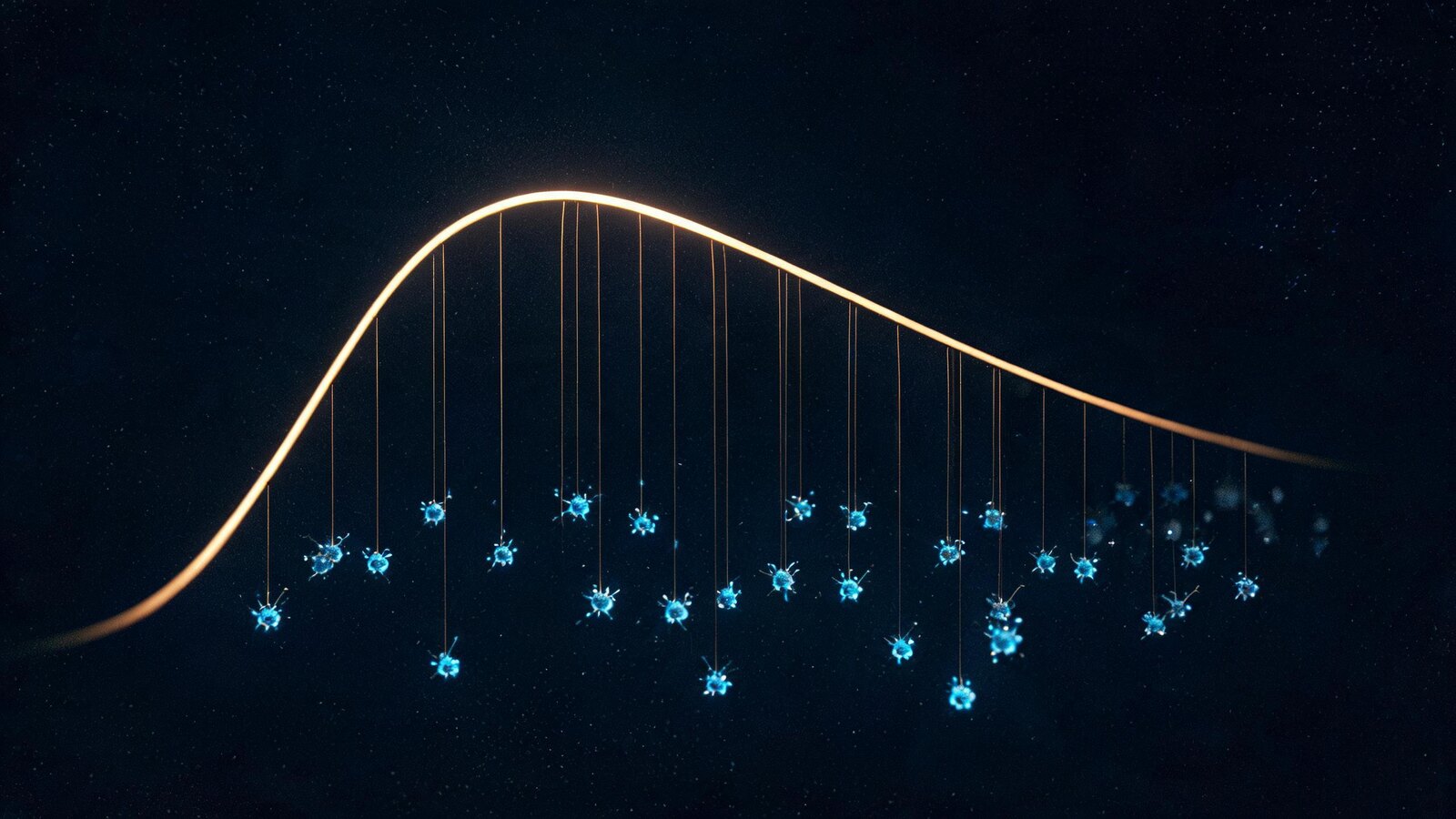
The results demolished the popular seven-year story. Most neurons in the cerebral cortex are approximately as old as the person who carries them. Many have been present since around birth and are not routinely replaced during a lifetime. Cardiomyocytes do renew, but astonishingly slowly: at age twenty-five, the estimated annual turnover is about one per cent; by age seventy-five, it falls to roughly 0.45 per cent. Cells in the intestinal lining, by contrast, may be replaced within days. The turnover rates of different tissues vary by orders of magnitude.
“Every cell is replaced in seven years” was not an old scientific conclusion later overturned by better evidence. There was never an experiment supporting it in the first place. The intestine, heart and brain each keep time differently. The body has no single calendar.
It is neither replaced wholesale every seven years nor held perfectly still. It changes at different speeds while preserving continuity.
Yet people do change. If the body cannot explain all of that change, memory becomes the next place to look.
3. The Remembered Self: A Man with Only Thirty Seconds
The two hippocampi lie deep within the brain, one in each hemisphere, their curved shape giving them the name of the seahorse. They are not the brain’s one and only memory vault. They are, however, crucial for transforming many present experiences into enduring episodic memories. When the hippocampal system is severely damaged, that route of conversion is largely broken: experience still arrives, but much of it cannot be stored for later recollection.
Modern neuroscience first learned this clearly from another patient. In 1953, the American Henry Molaison underwent surgery for severe epilepsy. Surgeons removed tissue from both medial temporal lobes, including much of the hippocampal formation. His seizures improved considerably. But for the next fifty-five years, he was almost unable to form new episodic memories. Neuropsychologist Brenda Milner studied him over decades, and that body of work helped establish the foundations of modern memory science. In the literature, he was known only as H.M.; his name became public after his death in 2008.
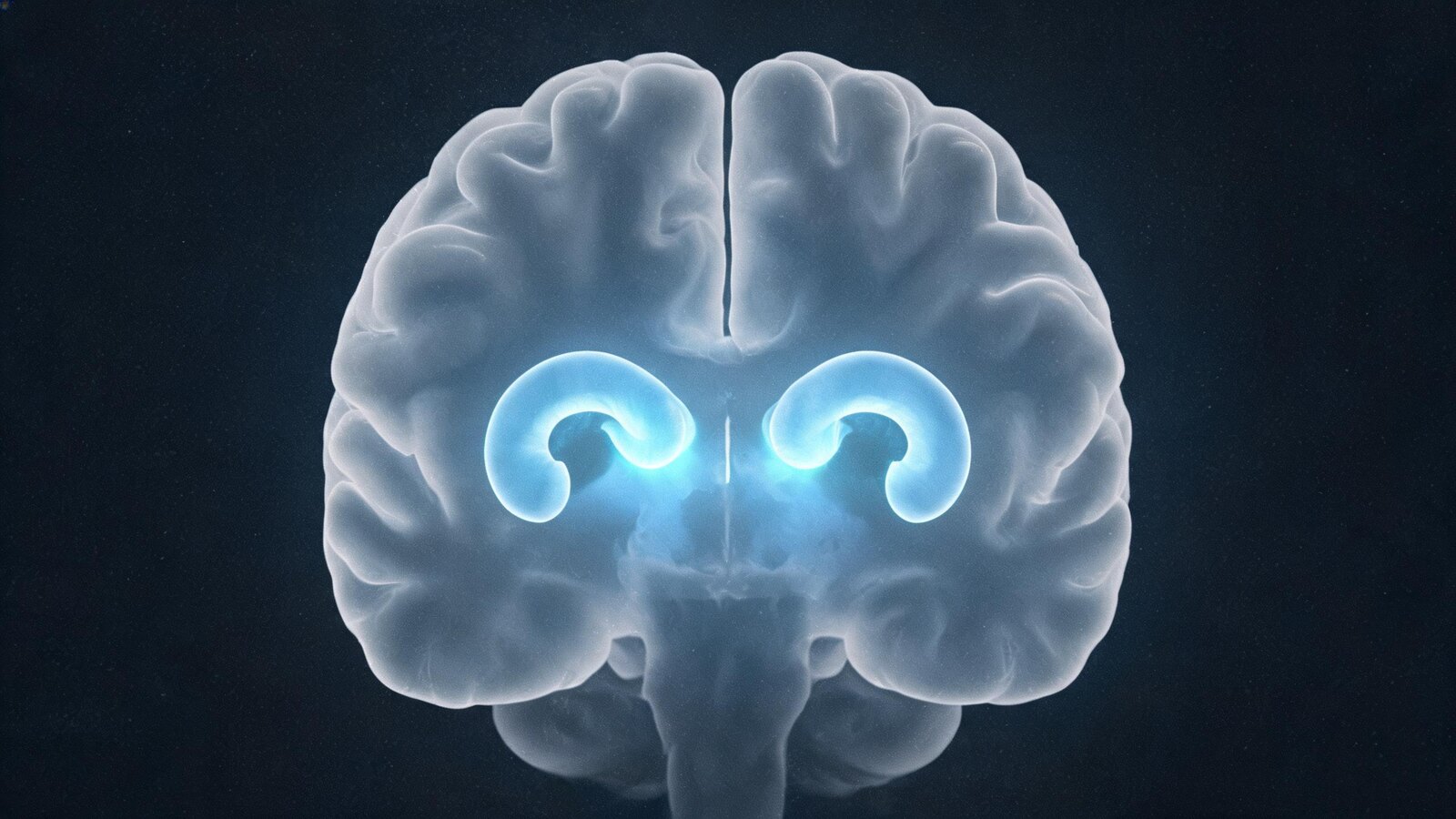
Wearing’s condition resembled Molaison’s but was more extensive because the viral damage reached farther. Clinically, this is called anterograde amnesia. Wearing remains one of the most severe documented cases.
Even so, saying that he “lost his memory” is too simple. He could not report what had happened minutes earlier, but his hands had not forgotten how to play. He could not recall that his wife had just visited, but when she entered again, love seemed to recognise her before recollection could.
Science divides remembering into several forms. Episodic memory preserves what happened to me. Semantic memory stores general knowledge. Procedural memory allows the body to learn how to ride a bicycle, swim or play an instrument. Familiarity and emotional responses to particular people may also persist. Wearing’s episodic memory was catastrophically impaired; these other capacities did not vanish with it.
That is why the surviving footage of his life is so difficult to watch without feeling the ground shift. He does not remember that Deborah was in the room moments ago, yet every time he recognises her as the person he loves. He cannot explain that he knows how to play the piano, yet once his hands touch the keys, the skill is exact. Milner found a comparable separation in H.M. When he practised a mirror-drawing task that required hand–eye coordination, his performance improved from day to day. At the beginning of each session, however, he had no memory of ever attempting it before.
Wearing lost one kind of memory. He did not lose the hands that could play, or the impulse to embrace Deborah when she appeared. We routinely place an equals sign between “who I am” and “what I remember.” In him, that equation split open.
For those of us whose memory systems are intact, a more unsettling question remains: how trustworthy are they?
4. Memory Can Lie and Sound Completely Convincing
In a suspense film, two adjacent shots can make us see an emotion that appears nowhere in either image alone. Place the same expressionless face after a bowl of soup and it seems hungry; place it after a woman in a coffin and it seems grief-stricken. The face has not changed, but the emotion perceived by the audience has. Film theory calls this the Kuleshov effect.
Editing changes how we interpret an image in the present. What happens next is more subtle: a word heard afterward can work its way backwards into memory, leaving a person convinced that it was part of what they saw.
Beginning in the 1970s, American psychologist Elizabeth Loftus conducted a series of experiments that would eventually change legal practice.
In one of the best known, participants watched the same film of a traffic accident and were then asked slightly different questions. One group was asked how fast the cars were going when they “hit” each other. Another was asked how fast they were going when they “smashed into” each other. Changing a single verb produced substantially higher speed estimates in the “smashed” group. A week later, when participants were asked whether they had seen broken glass, those who had heard “smashed” were more likely to say yes. There had been no broken glass in the film.
The result became known as the misinformation effect: information received after an event can become incorporated into memory of the event itself. Once the two have been blended, people may struggle to distinguish what they originally saw from what they later heard. Both may carry the same inner certainty of “I remember.”
More dramatic still was the 1990s study commonly known as “Lost in the Mall.” Researchers obtained three genuine childhood memories from each participant’s family and added a fourth, fabricated event: at around age five, the participant had supposedly become lost in a shopping mall, cried for a long time and was eventually reunited with their parents by an older woman. Participants were asked to remember all four episodes. Of the twenty-four people in the study, roughly a quarter reported some memory of the invented event. Some supplied details about the woman’s clothes. Others described their feelings. A few still found the truth difficult to accept when they were told that the incident had never happened. There had been no childhood separation in the mall.
The original study was small, and its interpretation has remained contested. In 2023, another team preregistered its methods and repeated and extended the work with 123 participants. Under criteria specified in advance, thirty-five per cent reported an account of the suggested event that had never occurred. Estimates vary with the procedure and with how a “false memory” is classified. What has not disappeared is the underlying fact: under suitable conditions, people can sincerely remember an event that did not happen.

Loftus later testified in hundreds of legal cases about the reliability of eyewitness memory. Her work forced courts to reconsider an assumption that had gone largely unchallenged for centuries: a sincere and unwavering witness can still be wrong. In a 2020 summary, the Innocence Project reported that 252 of the 367 DNA exoneration cases it had then counted involved eyewitness misidentification, about sixty-nine per cent. Those cases do not show that every confident identification is false. They show that confidence alone cannot establish accuracy.
Nor does any of this mean that all memory is fiction. Remembering is not the replay of an untouched recording. When a memory is retrieved and stored again, present beliefs, emotions and later suggestions may enter the reconstruction. The more fluently a story is told, the easier it becomes to trust. Its feeling of certainty may arise from accuracy, but it may also arise from rehearsal.
The past itself cannot be changed. What can change is whether one event is still allowed to pass sentence on an entire life. And what never happened cannot be made to have happened merely by being told often enough.
The body is less fixed than it seems. Memory is less reliable than it feels. What, then, is the thing that keeps turning those shifting fragments into the word “I”?
5. The Mind That Keeps Inventing Reasons
In the 1960s, some people with otherwise uncontrollable epilepsy underwent surgery to sever the corpus callosum, the great bundle of nerve fibres connecting the brain’s two hemispheres. The operation could prevent abnormal electrical activity from spreading from one side to the other. It succeeded, and in ordinary life many of the patients appeared largely unchanged.
Roger Sperry and his student Michael Gazzaniga discovered something strange, however. If information was presented to these patients under carefully controlled conditions, the two hemispheres could be shown different things. Sperry received the 1981 Nobel Prize in Physiology or Medicine in part for this work.
The basic arrangement is this: information in the left half of the visual field is initially processed by the right hemisphere, while information in the right half is initially processed by the left. In most people, the hemispheres exchange information continuously, so the division goes unnoticed. Once the corpus callosum has been severed, that exchange is greatly restricted. In a carefully designed experiment, the two sides can therefore receive different information. Language, meanwhile, is usually more dependent on the left hemisphere; in the classic cases, it was primarily the left hemisphere that could produce a spoken answer.
One experiment became a landmark of cognitive science. Researchers showed a split-brain patient identified as P.S. a chicken claw in his right visual field and a snowy scene in his left. They then asked him to select related pictures from an array, allowing him to use both hands. His right hand chose a chicken: the right hand is controlled by the left hemisphere, which had seen the chicken claw. His left hand chose a shovel: the left hand is controlled by the right hemisphere, which had seen the snow. Both choices made sense.
Then the researchers asked him why he had chosen them.
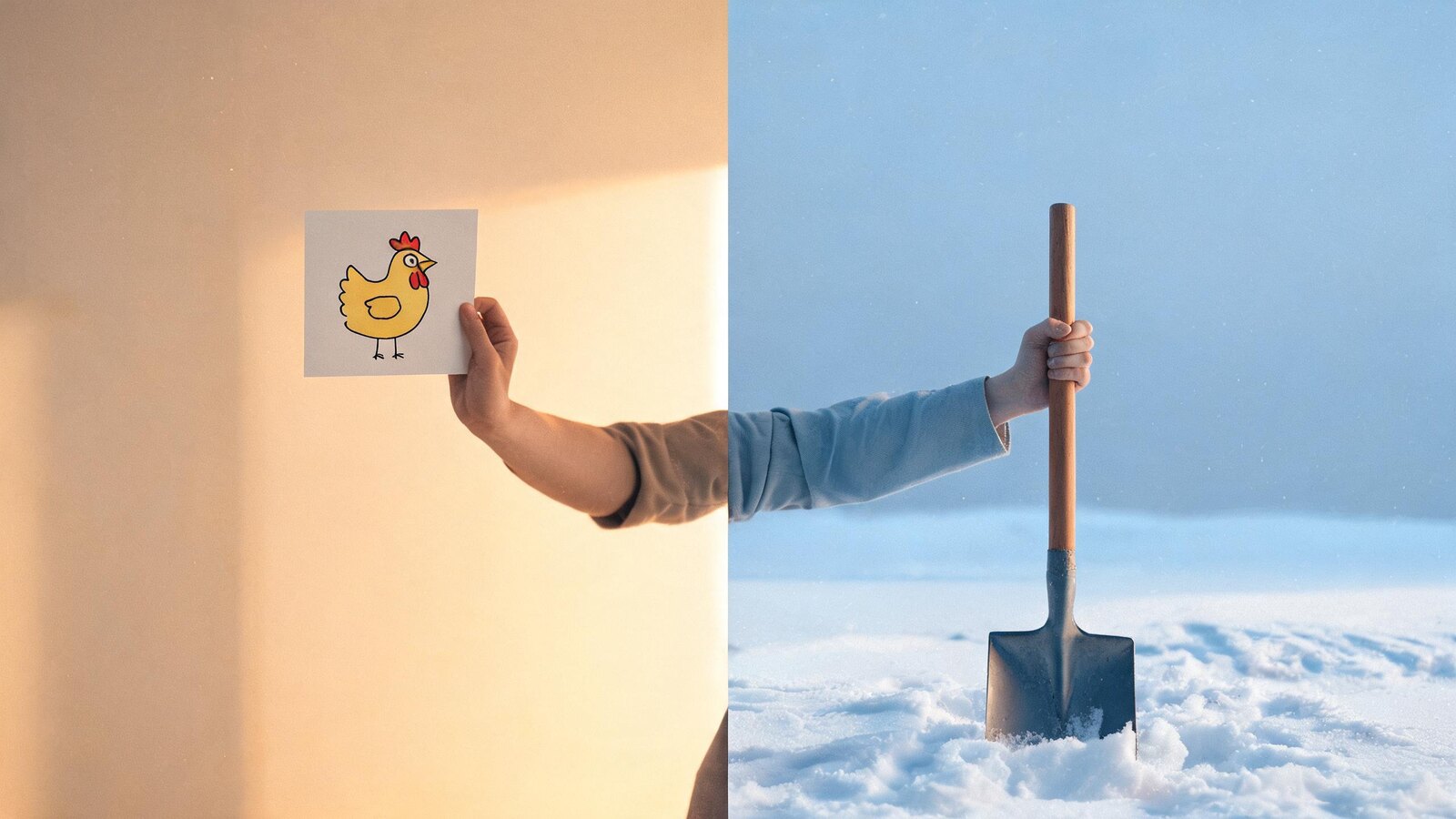
The hemisphere capable of answering aloud was the left. But it had never seen the snow. It did not know why the left hand had selected the shovel. Logically, all it could have said was, “I don’t know.”
Instead, P.S. replied:
“The chicken claw goes with the chicken, and you need a shovel to clean out the chicken shed.”
— Split-brain patient P.S., as reported by Michael Gazzaniga
He did not hesitate or signal that he was guessing. The left hemisphere, unable to see the snow, instantly supplied a coherent explanation for the shovel. Gazzaniga called this capacity the interpreter.
In the experiment, the speaking hemisphere had only the chicken claw, the chicken and the shovel. It used those fragments to close the gap and produce a complete story.
Split-brain surgery creates an exceptional condition. More recent research has also cautioned that some early accounts may have overstated how completely the two hemispheres become isolated. The experiments do not prove that every explanation we ordinarily give for ourselves is produced by one identical mechanism. They reveal a narrower but consequential possibility: when people do not know the real cause of an action, they can still produce a rapid, sincere and coherent explanation that may not be accurate.
A person’s explanation of their own behaviour does not necessarily come from the behaviour’s real cause. It may be a story added afterward.
Nor is the ordinary brain ever truly silent. Even when no one is asking us to justify anything, it revisits the past and rehearses the future.
6. When We Do Nothing, the Brain Stays Busy
At two in the morning, something that happened eight years ago suddenly returns with the clarity of yesterday. In your head, you replay the sentence you should have delivered then. This time it is perfect; the other person has no reply. The rehearsal ends. Dawn has not yet come, and the event is still exactly where it was eight years ago. Not a word of it has changed.
It may feel like nothing more than overthinking. Yet brain imaging began to reveal the activity inside such quiet moments more than two decades ago.
In 2001, Marcus Raichle and colleagues at Washington University in St. Louis described a set of brain regions that showed relatively greater activity when the demands of an external task were reduced. The network later became associated with remembering the past, imagining the future, considering other minds and thinking about oneself. It came to be called the default mode network.
It is not “where the self lives,” and resting is not the same as mind-wandering. Planning, empathy and autobiographical memory all engage parts of this network. When inner narration circles repeatedly around distress, psychology calls it rumination. Rumination is associated with some patterns of activity and connectivity in the default mode network, but the two are not equivalent.
In 2010, Harvard researchers used smartphones to ask thousands of people, at random moments, what they were doing, what they were thinking about and how they felt. The result was blunt: on average, people were less happy when their minds wandered than when their attention was on the activity in front of them. Repetition does not necessarily bring thought closer to the truth. Sometimes it merely makes one version of the story more familiar.
When the outer world grows still, the brain edits scattered memories, fears and imaginings into a new sequence. Before the next line reaches the diary, the mind has already drafted it.
If the self is a story under constant revision, how much can change before it becomes a different story?
7. The Teletransporter: Pushing the Question to Its Limit
Every night, you entrust yourself to a blank interval.
For several hours after you fell asleep last night, the person who woke this morning could give no account of what happened in between. Yet someone opened their eyes in your bed, possessed your memories, answered to your name and continued your life.
You do not normally doubt that this person is still you. Why not? The same body remains, and memory joins one day to the next. The machine imagined by Derek Parfit, however, seems able to provide both.
In 1984, the Oxford philosopher published Reasons and Persons. One of its thought experiments has been discussed ever since.
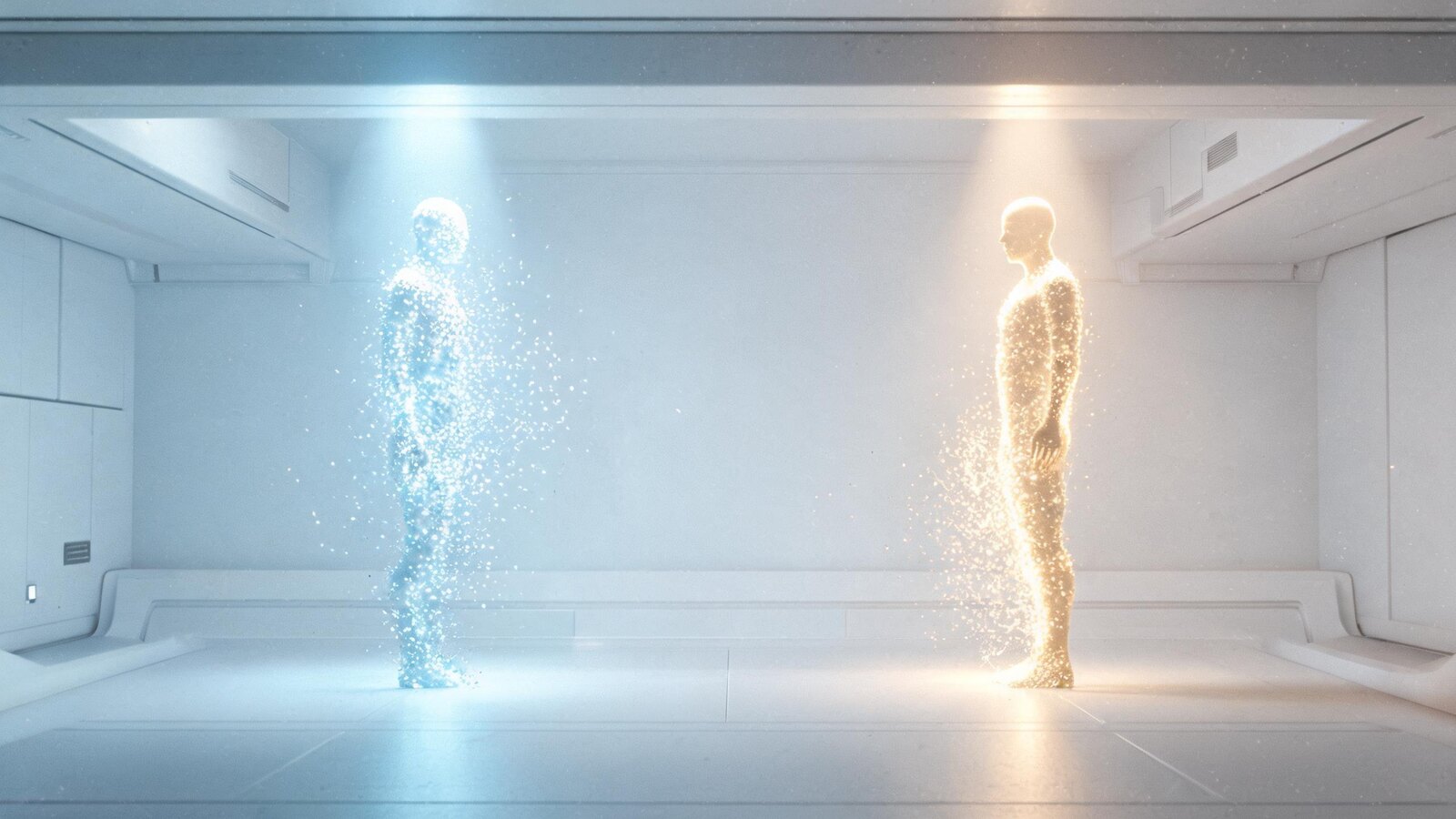
Imagine a teletransporter. You enter a chamber on Earth. The machine scans the position of every atom in your body, destroys that body, sends the information to Mars and rebuilds a person there from local matter. The person who awakens has all your memories, character and plans. From the inside, there is no felt break. They remember hesitating before entering the chamber, yesterday’s argument and the errand they intended to complete after returning.
Was that travel, or death followed by replication?
Many people’s first response is that the process amounts to death. Parfit then changes one detail. This time the machine malfunctions: the original body on Earth is not destroyed, while the replica on Mars wakes exactly as before. Now there are two people, each convinced that they are the person who entered the chamber, and each with an intelligible claim.
Nothing about the person on Mars differs between the two experiments. In the first, because the body on Earth has been destroyed, we may be willing to call the person on Mars “you.” In the second, solely because the Earth version survives, we suddenly resist doing so. Yet the malfunction on Earth has altered no feature of the person on Mars. If both are you, then one person has become two people whose lives will immediately diverge.
Parfit drew a counterintuitive conclusion: the question we keep asking, “Is that person really me?”, may have no determinate answer. More unsettlingly, it may not matter as much as we suppose.
“Identity is not what matters.”
— Derek Parfit, Reasons and Persons
What matters in survival, he argued, is psychological continuity and connectedness: the persistence over time of memories, intentions, dispositions and character. These relations come in degrees. They may be stronger or weaker. They do not require a separate yes-or-no fact that settles whether someone is numerically the same person. Asking for that absolute identity can be like asking for the exact instant when one river becomes another. The question may lack an answer not because we know too little, but because it presupposes a boundary absent from rivers and lives alike.
Parfit wrote that once his view changed, he became less concerned about the remainder of his own life and more concerned about the lives of others. The teletransporter is not evidence about death. It is a device for pushing the concept of “the same person” to its edge, where a hidden crack becomes visible.
Parfit retained psychological continuity as the relation that matters. More than a millennium earlier, Subhūti had asked a more radical question: was the self we struggle to preserve ever a fixed thing in the first place?
8. The Question Subhūti Asked
Near the beginning of the Diamond Sutra, the elder Subhūti asks the Buddha a question: where should a person committed to awakening place the mind, and how should that mind be brought under discipline?
The sutra unfolds from this question. It does not locate one permanent resting place for the mind. Instead, it repeatedly loosens attachment to appearances and to the self.
Buddhist analysis describes a person in terms of five aggregates, or skandhas: form, feeling, perception, mental formations and consciousness. Form includes the body. Feeling is the affective tone of experience. Perception recognises and categorises. Mental formations include volitions and habitual impulses. Consciousness discriminates what is present to experience. Each changes, each depends on conditions, and none stands alone. Beyond their interaction, no independent owner of the five can be found.
This is the teaching of anātman, or not-self.

“All conditioned phenomena are like a dream, an illusion, a bubble, a shadow; like dew or a flash of lightning. Thus should they be contemplated.”
— Vajracchedikā Prajñāpāramitā Sūtra (Diamond Sutra), in Kumārajīva’s Chinese translation
Another passage says that the mind of the past cannot be grasped, the mind of the present cannot be grasped, and the mind of the future cannot be grasped. Time cannot be held. The deeper incision is that the one who wants to hold it cannot be found as an unchanging entity either.
Not-self does not mean that you do not exist. Breath, pain, love and responsibility do not disappear. It means that outside these changing processes, no permanent and independently existing owner can be located. Likewise, to say that the five aggregates are “empty” is not to say that they are absent. Emptiness means that nothing contains a self-sufficient, condition-free and immutable foundation.
To read not-self as nihilism is to read it backwards. Removing the idea of a fixed core does not excuse indifference. It lets us see which conditions repeatedly call the same response into being.
Consider the sentence, “I was born hot-tempered.” If temper is an essence, it can only be accepted. But if anger reliably appears when a certain situation, bodily state and cluster of old habits come together, those conditions can be changed one by one. Buddhism calls this conditional arising: dependent origination. When conditions change, responses gain room to change with them.
Yogācāra philosophy pressed the inquiry one step farther inward: why do we keep mistaking these changing processes for a fixed “I”?
9. Manas: The Process That Recognises a “Me”
In India around the fourth and fifth centuries, the brothers Asaṅga and Vasubandhu became central figures in the development of the Yogācāra tradition. Centuries later, Xuanzang travelled west in search of Buddhist teachings and, after returning to China, translated and systematised texts that became foundational to East Asian Yogācāra, including the Cheng Weishi Lun.
Yogācāra distinguishes eight modes of consciousness. The first five correspond to sight, hearing, smell, taste and bodily sensation. The sixth performs conceptual thought and judgement. The eighth, ālaya-vijñāna, is often rendered “storehouse consciousness”: a continuously changing basis in which the “seeds” left by experience are retained. The seventh is manas. It takes the ongoing activity of the storehouse consciousness as its object and continually appropriates it as a substantial “I.” The traditional phrase “constant scrutiny and deliberation” describes this uninterrupted attachment to self.
Across more than fifteen centuries, this account seems to touch the same broad difficulty as Gazzaniga’s experiment with the chicken claw, snow and shovel: we assume the self was there first, while both lines of inquiry ask how the feeling of “I” is repeatedly produced.
Resemblance, however, is not mutual proof. Split-brain experiments show that under a particular surgical condition and in specific tasks, people may confabulate an explanation for an action whose cause is unavailable to the speaking hemisphere. Yogācāra asks how attachment to self persists throughout experience. They may resemble two observers on different sides of a mountain who both hear someone call “I,” but they are not holding the same map.
It would therefore be wrong to say that Buddhism predicted neuroscience fifteen hundred years in advance. It would be equally wrong to say that neuroscience has proved Buddhism. The first claim reduces a philosophical and contemplative tradition to a premature scientific theory; the second reaches beyond what the experiments can establish.
Both encounter the same difficulty: what feels most self-evidently like “me” may be precisely what is hardest for me to see. If so, self-knowledge cannot be achieved only by thinking alone in a closed room.
10. Which Self Are We Trying to Know?
Now Socrates’ refusal to rush into answers makes more sense.
If the third layer of the self is produced through continual narration, it cannot be changed simply by inserting one correct sentence from the outside. A person may wholeheartedly agree with “You should not be so hard on yourself,” then continue the same self-punishing narration without interruption. Intellectual agreement is not the same as changed habit. Understanding and response do not always move together.
Questioning helps because it forces the narration itself into speech. The moment a person says it aloud, the narrator also becomes a listener. Many statements feel unassailable in the privacy of the mind but begin to loosen once heard. “I never manage to do anything right” may have lived comfortably for years only because it was never brought into the light, where counterexamples could appear.
Speaking the story is only the beginning. The next question is whether it changes what a person does.
That was the problem pursued by Wang Yangming.
In 1506, during the first year of the Zhengde reign, Wang submitted a memorial defending officials persecuted by the powerful eunuch Liu Jin. He was flogged and demoted to a remote post at Longchang in Guizhou. He arrived about two years later. The climate was harsh, local languages were unfamiliar, and the people who had accompanied him fell ill one after another. Wang was himself in peril, yet he continued caring for them. In that isolation, he repeatedly confronted questions of life, death, gain and loss. He asked what a sage could do if placed in exactly his circumstances.
One night, according to the traditional account, he experienced the breakthrough later called the Longchang enlightenment. He later condensed one of his central claims into a short formula: xin ji li (心即理), “the mind is principle.”
“The mind is principle.”
— Wang Yangming, Instructions for Practical Living (Chuanxilu)
“Mind” here does not mean that whatever I imagine must become reality. It is not a philosophy of wishing. Wang’s claim is that moral judgement cannot hide entirely behind rules located somewhere outside us; it must return to the moral knowledge already present in us, here and now.
The practical method for which he became best known was the unity of knowledge and action.
Wang rejected the idea that knowing and doing can be divided into two consecutive stages: first understand the principle, then someday act on it. A person who can lecture brilliantly about filial care yet never looks after their parents does not truly know what such care means. Genuine knowledge already includes action.
In an ordinary life, the unity of knowledge and action has a concrete implication. A self does not change merely because it acquires a new interpretation. It changes when a person does something different. Once that action has occurred, the next story a person tells about themselves contains a new fact that cannot simply be erased.
But how can the old sentence first become audible to the person repeating it?
11. Let Someone Else Hear You
First, the story has to be spoken.
The difficulty is that the people closest to us are often the hardest people to tell. A friend is already inside the situation: they know whom you resent, and their advice carries their own loyalties. A parent or elder offers an answer shaped by another generation, an answer that may have been right within their circumstances. With the person you love most, you may be most afraid to speak, because you understand too well what will have to be faced afterward.
There are moments in almost every life when one question sits heavily inside. To ask it risks judgement; not to ask it leaves no path around it. The problem is not a lack of words. It is the absence of a place where the words will not be immediately corrected, soothed away or converted into someone else’s verdict.
Some questions cannot be answered by the people around us. Thinkers who have wrestled with those questions across generations may cast light from another direction.
Some questions need more than one voice.
SageSight.ai, from Vignis, brings philosophers and sages from different cultures and centuries into conversations you can enter at any time.
Bring the same question to Socrates, and he will test its premises. Subhūti will ask about the “I” hidden inside the sentence. Wang Yangming will return the insight to action. Laozi may ask whether force itself has become part of the problem.
They do not decide for you. They help you say, more completely, the question you have not yet been able to finish. The answer remains yours.
Continue the inquiry with Socrates, Subhūti, Wang Yangming, and Laozi on SageSight.ai — from Vignis.
But seeing a story clearly does not give anyone the power to rewrite the facts.
12. What Can Be Rewritten Cannot Simply Be Erased
The absence of a fixed self does not mean that nothing matters. The opposite follows. Precisely because there is no permanently inscribed foundation, what you do today genuinely becomes part of what follows. If you have hurt someone, “That was not the person I am now” cannot dissolve the harm. A wrong action does not disappear because it has been retold in a kinder voice. The capacity to change begins with the courage to acknowledge what happened.
Responsibility does not require nailing yourself to one mistake for the rest of your life. It means admitting it, repairing what can still be repaired, and choosing differently enough that today no longer repeats it.
Discovering that memory reconstructs and explanation fills gaps does not mean that you must distrust every feeling.
Grief is real. Fear is real. The tightening in your chest when you feel ignored is real. What deserves another question is the sentence that arrives immediately afterward: “They did that because I am unlovable.” “This failure proves I will never succeed.” You can trust the pain without automatically trusting the judgement pain has made on your behalf.
The body changes, but it does not become a different body overnight. Memory is reconstructed, but it cannot turn something that never happened into a fact. What can begin to loosen today is the sentence you keep repeating to yourself.
The next step can change. The facts, the feelings and the responsibility remain.
13. You Can Tell the Story Differently
Clive Wearing can retain almost no new episodic memory. Yet he recognises his wife. He can still make music.
We often imagine the self as a storehouse containing experiences, habits and identity. Empty the storehouse, and the person must be gone. Wearing’s principal route for retaining episodic experience was almost severed, yet the person remained.
Standing beside his piano, it is difficult not to see this: he is not only someone preserved from the past. He is someone still unfolding in the present. His fingers meet the keys. Deborah enters, and he moves to embrace her. These are also Clive Wearing. They do not have to be remembered later in order to have been real now.
For people without his neurological injury, the story is also being edited each day: what stays, what is skipped, and what is repeated until it hardens into a verdict.
This is just who I am.
I have always been like this.
I cannot change.
You have probably said some version of these sentences to yourself. They sound like conclusions, the objective findings of years of observation.
But they are sentences.
The split-brain experiments support a limited conclusion: people can explain actions whose real causes they do not know. Old stories in ordinary life can perform another kind of completion. They turn one retreat into a personality, assign one success to luck, and connect three failures into “I never get anything right.”
The harm goes beyond how these sentences make you feel. They make decisions on your behalf.
The application you wanted to submit remains unsent. The apology that needed saying is postponed again. A relationship that should have ended continues for another year. Something you wanted to learn stops on the third day. In the moment, these choices rarely feel like surrender. They feel like realism. Yet that apparently objective “reality” is often only the boundary drawn by an old story.
The Ming-dynasty scholar Yuan Liaofan once spent twenty years trapped by a fortune-teller’s sentence. More often, the sentence that traps us requires no one else to say it.
Telling the story differently is not self-deception. It is not calling failure success. It means acknowledging that one account is only one account, then asking how else the same facts can be understood. “I am a coward” and “I was unprepared that time, and now I know what I need to prepare” face the same past. They lead toward profoundly different tomorrows.
The more honest version is not necessarily the more flattering one. It is the one that does not discard the facts that fail to fit the verdict: what you have completed, who has trusted you, and the occasion when you did not run away.
Then comes another question: can you do one thing tomorrow that the old story would not predict?
Because what you do tomorrow becomes a new fact that the old conclusion will struggle to explain away. Action forces the inherited story to surrender a little ground. This is the practical force of Wang Yangming’s unity of knowledge and action: understanding alone is not enough. The act counts.
Socrates said that the unexamined life is not worth living. The word “examination” may sound weighty. But it starts small:
Say the sentence you keep telling yourself. Listen to it once.
Clive Wearing writes, “I am completely awake for the first time,” then crosses it out. Minutes later he writes it again.
He is not refusing to remember the previous line.
He cannot remember it.
You can.
But you have evidence against it. You finished something you believed you could not do. Someone once thanked you, sincerely, for your help. During the most difficult season, you endured longer than you thought possible. None of these moments has disappeared. They were simply never admitted as evidence by the old story.
Every time you write “I cannot change,” those moments become like the previous line in Wearing’s diary: crossed out, overlooked once again.
He has no choice.
You do.
References
[1] Wearing, D. (2005). Forever Today: A Memoir of Love and Amnesia. London: Corgi.
[2] Wilson, B. A., Kopelman, M., & Kapur, N. (2008). “Prominent and persistent loss of past awareness in amnesia.” Neuropsychological Rehabilitation, 18(5–6), 527–540.
[3] Sacks, O. (2007). “The Abyss: Music and Amnesia.” The New Yorker, 24 September 2007.
[4] Plato. Apology. In Complete Works, ed. J. M. Cooper. Indianapolis: Hackett, 1997.
[5] Parke, H. W., & Wormell, D. E. W. (1956). The Delphic Oracle. Oxford: Blackwell.
[6] Spalding, K. L., Bhardwaj, R. D., Buchholz, B. A., Druid, H., & Frisén, J. (2005). “Retrospective Birth Dating of Cells in Humans.” Cell, 122(1), 133–143.
[7] Bergmann, O., et al. (2009). “Evidence for Cardiomyocyte Renewal in Humans.” Science, 324(5923), 98–102.
[8] Scoville, W. B., & Milner, B. (1957). “Loss of recent memory after bilateral hippocampal lesions.” Journal of Neurology, Neurosurgery & Psychiatry, 20(1), 11–21.
[9] Corkin, S. (2013). Permanent Present Tense: The Man with No Memory, and What He Taught the World. New York: Basic Books.
[10] Squire, L. R. (2004). “Memory systems of the brain: A brief history and current perspective.” Neurobiology of Learning and Memory, 82(3), 171–177.
[11] Tulving, E. (1972). “Episodic and Semantic Memory.” In Organization of Memory. New York: Academic Press.
[12] Loftus, E. F., & Palmer, J. C. (1974). “Reconstruction of automobile destruction.” Journal of Verbal Learning and Verbal Behavior, 13(5), 585–589.
[13] Loftus, E. F., & Pickrell, J. E. (1995). “The formation of false memories.” Psychiatric Annals, 25(12), 720–725.
[14] Loftus, E. F. (2005). “Planting misinformation in the human mind: A 30-year investigation of the malleability of memory.” Learning & Memory, 12(4), 361–366.
[15] Innocence Project. (2020). “How Eyewitness Misidentification Can Send Innocent People to Prison.” innocenceproject.org.
[16] Sperry, R. W. (1982). “Some Effects of Disconnecting the Cerebral Hemispheres.” Nobel Lecture. Science, 217(4566), 1223–1226.
[17] Gazzaniga, M. S., & LeDoux, J. E. (1978). The Integrated Mind. New York: Plenum Press.
[18] Gazzaniga, M. S. (2000). “Cerebral specialization and interhemispheric communication.” Brain, 123(7), 1293–1326.
[19] Gazzaniga, M. S. (2011). Who’s in Charge? Free Will and the Science of the Brain. New York: Ecco.
[20] de Haan, E. H. F., et al. (2020). “Split-Brain: What We Know Now and Why This is Important for Understanding Consciousness.” Neuropsychology Review, 30, 224–233.
[21] Raichle, M. E., et al. (2001). “A default mode of brain function.” PNAS, 98(2), 676–682.
[22] Buckner, R. L., Andrews-Hanna, J. R., & Schacter, D. L. (2008). “The Brain’s Default Network.” Annals of the New York Academy of Sciences, 1124, 1–38.
[23] Killingsworth, M. A., & Gilbert, D. T. (2010). “A Wandering Mind Is an Unhappy Mind.” Science, 330(6006), 932.
[24] Parfit, D. (1984). Reasons and Persons. Oxford: Oxford University Press.
[25] Shoemaker, S., & Swinburne, R. (1984). Personal Identity. Oxford: Blackwell.
[26] Kumārajīva, trans. Vajracchedikā Prajñāpāramitā Sūtra (Diamond Sutra). CBETA, T08, No. 235.
[27] Yin Shun. Lectures on the Prajñā Sūtras [《般若经讲记》]. Taipei: Zhengwen Publishing.
[28] Xuanzang, trans. Cheng Weishi Lun [《成唯识论》]. CBETA, T31, No. 1585.
[29] Han, Tingjie. (1998). A Collated and Annotated Cheng Weishi Lun [《成唯识论校释》]. Beijing: Zhonghua Book Company.
[30] Kimura, Taiken. A Study of Early Buddhist Thought [《原始佛教思想论》], trans. Ouyang Hancun.
[31] Wang, Shouren. Instructions for Practical Living [《传习录》] and Chronological Biography [《年谱》]. In The Complete Works of Wang Yangming. Shanghai: Shanghai Classics Publishing House, 2011.
[32] Chen, Lai. (2013). The Realm of Being and Non-Being: The Spirit of Wang Yangming’s Philosophy [《有无之境:王阳明哲学的精神》]. Beijing: Peking University Press.
[33] Mou, Zongsan. (1983). Nineteen Lectures on Chinese Philosophy [《中国哲学十九讲》]. Taipei: Student Book Co.
[34] Seth, A. (2021). Being You: A New Science of Consciousness. London: Faber & Faber.
[35] Metzinger, T. (2003). Being No One: The Self-Model Theory of Subjectivity. Cambridge, MA: MIT Press.
[36] Dennett, D. C. (1992). “The Self as a Center of Narrative Gravity.” In Self and Consciousness: Multiple Perspectives. Hillsdale, NJ: Erlbaum.
[37] Schacter, D. L. (2001). The Seven Sins of Memory. Boston: Houghton Mifflin.
[38] Pennebaker, J. W., & Smyth, J. M. (2016). Opening Up by Writing It Down, 3rd ed. New York: Guilford Press.
[39] Murphy, G., Dawson, C. A., Huston, C., et al. (2023). “Lost in the mall again: a preregistered replication and extension of Loftus & Pickrell (1995).” Memory, 31(6), 818–830. doi: 10.1080/09658211.2023.2198327.
[40] Mobbs, D., Weiskopf, N., Lau, H. C., Featherstone, E., Dolan, R. J., & Frith, C. D. (2006). “The Kuleshov Effect: the influence of contextual framing on emotional attributions.” Social Cognitive and Affective Neuroscience, 1(2), 95–106.