Beyond Inception: Who Is the Person Who Comes Back in Your Dreams?
Dreams, out-of-body experiences, and the idea of a connection to higher dimensions
Did you dream last night of someone who has long since left your life?
They were sitting where they always sat, calling your name in the voice you remember. In the dream, there was no farewell and no empty chair. You talked as you once did. By morning, the words had vanished, but the familiarity remained.
Daylight reaches the room. It looks exactly as it did when you fell asleep. The chair is empty again.
Why can a reunion that happened only in a dream leave behind a longing that is real? Who, exactly, came to see you?
1. Why Mal Didn’t Need the Top
In Inception, Cobb makes his living stealing secrets from other people’s dreams. He carries a small spinning top. When he is unsure where he is, he sets it turning: in ordinary reality it will fall; in a dream, it may keep spinning. It seems a serviceable test—until Mal appears.
The top was hers before it was his, a private object whose precise weight and feel she knew. Cobb has borrowed the test by which his dead wife once judged the world. What he carries is not simply a tool. It is one of the last things she left behind.
Mal does not enter his dreams on the team’s schedule. She appears near a window, in a hotel room, at the far end of a corridor just when he needs to move. Cobb knows to duck when an enemy raises a gun. Mal has only to look at him, and he slows. He knows the woman before him is a projection shaped by memory. Yet the voice and gestures are close enough to pull him back to the night he cannot bear to revisit.
The young architect newly recruited to design the dream worlds notices the danger. Mal keeps breaking into Cobb’s dreams, and he keeps stopping for her. She is not part of the assignment; she is a memory he cannot put down or reliably control.
This time the assignment is the reverse of theft: the team must plant an idea in a man’s mind so that, on waking, he believes it is his own. Cobb knows the cost because he once did it to Mal. Two children are waiting for him at home, but after Mal’s death he is a wanted man, unable to return to them. His employer promises a way home if the job succeeds. Cobb is risking his life to reach his children, while the person he has lost stands in the middle of the road.
Why can someone who knows a dream figure is his own creation still be stopped by her?
Before answering, there is a more basic question: can a dreaming person hear anyone on the other side?

2. Someone Answered a Question From Inside a Dream
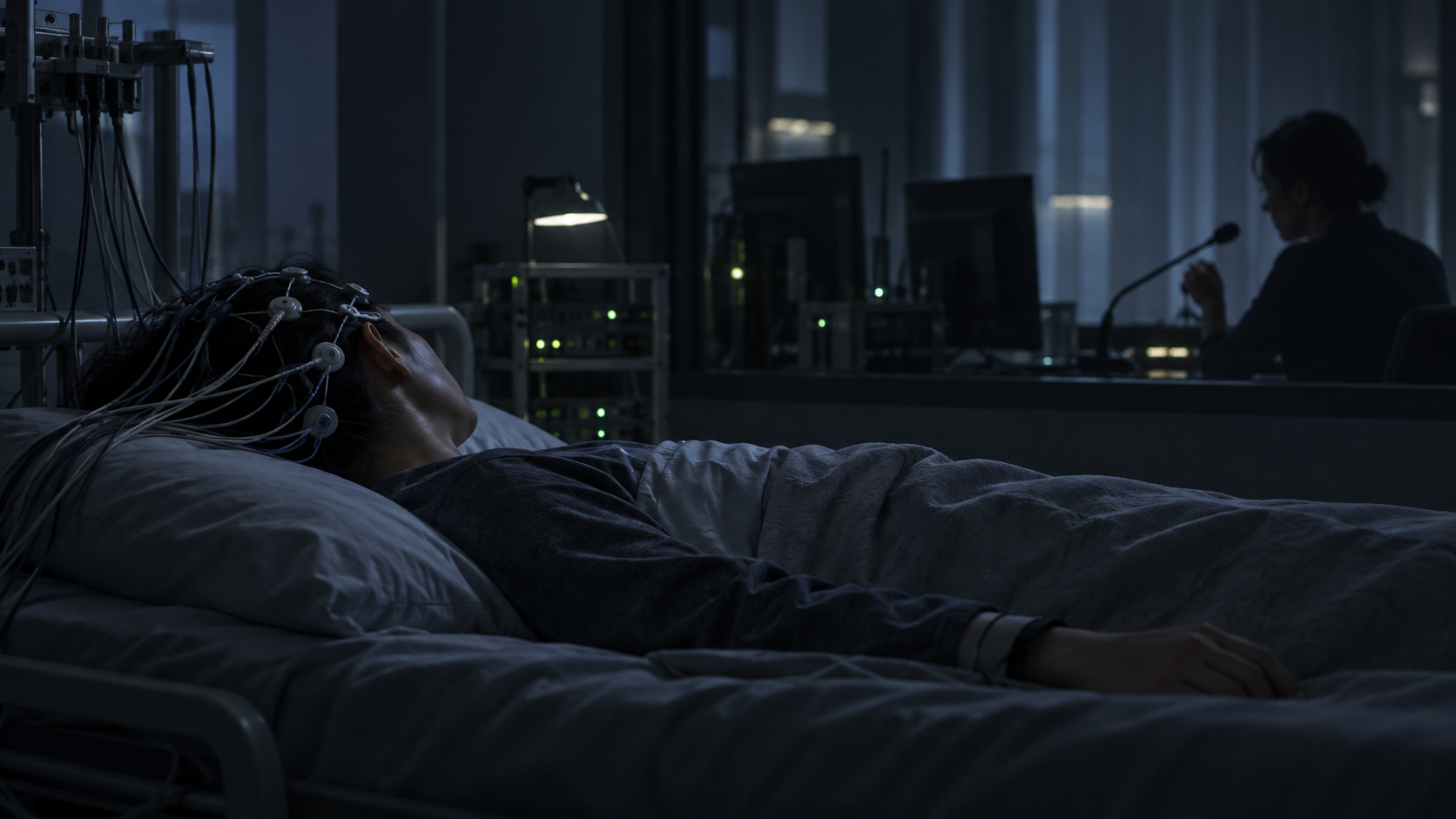
In 2021, four research teams—in the United States, France, Germany, and the Netherlands—reported an unusual experiment. A participant slept in a laboratory while instruments confirmed rapid-eye-movement, or REM, sleep. A researcher asked a simple question aloud. In one recorded example, it was a subtraction problem: eight minus six.
The sleeper did not wake. Their eyes moved in a pattern agreed upon before bed. The answer was two.
Across the four teams, six people gave correct answers on twenty-nine occasions. Far more often, a question received no usable reply. The people who succeeded were having lucid dreams: they knew, while dreaming, that they were asleep. The replies could be made through eye movements or small contractions of facial muscles. Because the question and response were recorded during sleep, the result did not depend solely on what a person remembered after waking. [1]
The limit matters as much as the answer. The person outside the dream was a researcher whose identity was known; the message was a short question, not an implanted belief. Nobody entered another person’s dream as Cobb does. What the study showed was narrower, and remarkable enough: sometimes a sleeping person can register a question from the room and reply with a prearranged movement.
For a long time, researchers often had to wait for a dreamer to wake and tell a story already fading. Here, a question and an answer left traces while the dream was still happening. The dream itself remained mostly out of view. But the door between sleep and waking was no longer quite soundproof.
3. If You Want to Know You’re Dreaming
Cobb needs a machine and a tube to enter a dream. Real lucid dreamers have less glamorous methods.
In the morning, before reaching for your phone, write down a person, a sentence, or a doorway from the dream you just had. Before sleep, recall a recent dream and imagine recognizing it if it returns: The next time I see this, I will know I’m dreaming. During the day, some people also check a clock, look away, and look back—not as a magic trick, but as a cue to ask seriously why they believe they are awake.
Research suggests that remembering dreams and setting an intention can help some people become lucid. A brief period of reality-testing alone has not shown the same clear benefit. No method guarantees that tonight will be the night. [4]
And knowing you are dreaming is not the same as controlling what happens next. Some people wake the instant they realize it. Others can change their own actions but cannot summon the person they want to meet. A street or room may continue to develop on its own terms.
That is Cobb’s problem. No one knows more clearly than he does that he is dreaming. Mal still walks toward him from the end of the corridor.

4. Cobb Closes the Elevator. Mal Comes Back Anyway.
To understand why she keeps returning, the film takes us to the years Cobb and Mal spent together in limbo. Only a short time passes outside; inside the dream, they build a city by the sea and grow old there. Mal comes to accept that world as real. Desperate to bring her home, Cobb plants a thought in her mind: this world is not real.
She wakes. The thought does not.
Back in ordinary life, Mal still believes she is dreaming and that dying will wake her again. On their anniversary, she steps from a hotel window. Cobb has brought her out of limbo, but he cannot leave the idea there.
Afterward, he constructs an elevator into his memories. At its lowest floor is the hotel room where he keeps an image of Mal. He goes down to see her, then shuts the door when he leaves. During his assignments, she emerges anyway.
We cannot build that elevator, but we recognize the impulse. Someone takes a screenshot before deleting an old conversation, then hides the screenshot in an album they rarely open. Someone moves a name to a folder they think they will not check. Someone says, aloud, that today is the day they will stop thinking about it. Put the entrance away, and perhaps the person will stop appearing.
A 2004 study gives that impulse an unsettling reply. Before bed, participants wrote for five minutes under different instructions about a person they knew. Those told to suppress thoughts of that person were more likely to dream of them than comparison groups. The finding concerns the dreamer’s own thoughts; it says nothing about whether the other person was thinking of them that night. [3]
We can close a conversation window. We cannot always order the mind not to open it again.

5. If You Keep Dreaming of Someone, Are They Thinking of You?
The person who returns in your dreams may not have died. Perhaps a relationship ended without an explanation you could live with.
In the dream, the argument never happens. They sit beside you and say your name as they used to. On waking, the question comes almost before the light does: Were they thinking of me too? Is that why they keep appearing?
The dream cannot answer for them. To know whether a bond still has a life outside sleep, you have to look at what happens while both of you are awake: a call, an answer, a meeting one of you actually chooses to make. The person in the dream may also be carrying something else for you—a sentence never explained, a goodbye that never happened, or the version of yourself that once felt deeply loved.
A dream can return you to the old room. It cannot bring back the other person’s present life with it.
When the person has died, the answer is quieter and harder to ask.
6. The Person Who Returns Looks Like They Used To
In a dream, they may be healthy and young. They sit in the familiar chair and say something only the two of you would understand. For a few minutes you forget they are gone. Then you wake, the room is still, and you lose them again.
The face did not arrive from nowhere. You heard that voice for years. You watched them sit that way for years. Words you could not say in daylight can find their way into that room at night. One person wakes grateful for another encounter; another feels the empty chair more sharply. Comfort and grief can leave the same dream together.
Psychology can investigate how memory and emotion take part in dreams. It cannot settle for every bereaved person whether a loved one has somehow returned. Some understand the encounter as the mind living with loss. Others choose to believe that the person came back for a while. A scientific account of dream formation is not a license to dismiss what the meeting meant to the dreamer.
There is also a practical difference between a dream you want to keep and a nightmare you dread. Imagery rehearsal therapy asks a person, while awake, to rewrite a recurring nightmare with a less threatening ending and practice the new version. It has been studied as a treatment for chronic nightmares, including in people with post-traumatic stress disorder. It does not erase the past; it gives the sleeping mind another route through a scene that keeps returning. [6]

7. An Electrical Current Moved the Sense of “Me”
Stories about dreams sometimes lead to claims that the soul left the body. One case from 2002 is worth looking at carefully.
A woman undergoing evaluation for epilepsy had electrodes placed on the surface of her brain. Doctors stimulated different sites to help locate the source of her seizures. When they stimulated an area on the right called the angular gyrus, she reported sensations of sinking and falling. With further stimulation, she described looking down at her body on the bed from above. Her body had not moved. Her sense of where she was had shifted. [2]
One patient cannot explain every out-of-body experience. The case does, however, show that disrupting the brain’s integration of bodily and spatial signals can produce an experience of leaving one’s body that feels immediate to the person having it.
Some readers will recognize a different night-time moment: waking in their own room, unable to move, while feeling that someone is standing nearby. This is commonly called sleep paralysis. During REM sleep, most voluntary muscles are temporarily inhibited. Sometimes awareness returns before that inhibition has fully lifted, and dream imagery or a sense of presence can linger. The room is real. The inability to move is real. So is the fear. Telling the person that it was “only imagination” misses what those seconds felt like. [5]
Lucid dreaming and an out-of-body experience are not interchangeable. In a lucid dream, you recognize that you are dreaming, and the scene might be anywhere. In an out-of-body experience, the scene often remains anchored to your own bed and room while your point of view seems to rise away from them. The 2002 case did not take the patient to an unknown world. It changed her view of the most familiar place in the room: her own body lying there.

8. Suppose Someone in a Dream Says They Come From a Higher Dimension
What follows is a thought experiment, not a reported experiment or anyone’s documented experience.
Imagine that you have learned to recognize a lucid dream. Tonight, you meet a stranger on a dream street. You ask who they are. They say they come from a higher dimension and then tell you something you never expected. You did not prepare their lines; you cannot predict the next sentence. For a moment, they feel nothing like a character you made.
What do you do when you wake?
First, consider what was said. If the stranger named something you have been avoiding, write the conversation down. It may have brought a thought into focus that you had not managed to say in daylight. We sometimes understand what we mean only after we hear ourselves speak. An unexpected sentence in a dream need not have arrived from outside the mind.
If the stranger claims to bring news from outside the dream, preserve their exact words and the time you wrote them down. Decide in advance what would count as a specific, testable match. A single apparent hit can be chance; a vague prediction remembered after an event is especially easy to reshape. The distinction is between words recorded before something happens and a story reconstructed afterward.
“Higher dimensions” is also a term in physics, but it has a different job there. Some theories propose additional dimensions beyond the three spatial dimensions we experience. Physicists seek possible signatures in particle collisions, such as certain new particles or missing energy. None of this establishes a place where souls live, or a channel through which dreams receive messages. [7]
The 2021 sleep study established a limited exchange between researchers in a room and people in lucid dreams. It did not identify dream characters as visitors from elsewhere. A dream conversation may still give you an idea worth keeping. If it makes a claim about the outside world, that claim needs evidence gathered outside the dream.

9. Cobb Stops Watching the Top
Near the end of Inception, Cobb faces Mal one last time in limbo. He finally turns away from the image of her and goes to find someone else who has not yet made it home.
Later, his children run toward him. He sets the top spinning on a table. Before it stops—or fails to—he walks to them. The film cuts away.
Viewers still argue over the top. Cobb is no longer looking at it.
It was once Mal’s way of testing the world. Now, on that table, it has stopped being the thing that decides what Cobb does next.
Perhaps no top will settle our own questions: whether dreams connect to higher dimensions, whether a soul travels at night, whether the person who came back to us came from memory or somewhere else. The fear, tenderness, or longing you felt in the dream does not become worthless because a brain helped make it. A film is made of light and sound; that does not stop us crying in the dark.
Morning comes. The room looks as it did when you fell asleep. The chair is empty.
You sit on the edge of the bed, pick up your phone, and open a conversation you have not looked at for a long time.
Your thumb waits above the screen.
Slowly, you type: I dreamed of you last night.
You do not press send. Before the screen goes dark, the sentence is still there in the message field.

Continue with Vignis Thinks
Dreams can take us back to an old room, but they also return us to questions we have not finished asking. Continue through memory, fate, and consciousness in the Vignis Thinks library.
Explore the Vignis Thinks long-read index →

References and Further Reading
- Konkoly KR, et al. “Real-time dialogue between experimenters and dreamers during REM sleep.” Current Biology. 2021;31(7):1417–1427.e6. URL: https://doi.org/10.1016/j.cub.2021.01.026
- Blanke O, Ortigue S, Landis T, Seeck M. “Stimulating illusory own-body perceptions.” Nature. 2002;419:269–270. URL: https://doi.org/10.1038/419269a
- Wegner DM, Wenzlaff RM, Kozak M. “Dream rebound: the return of suppressed thoughts in dreams.” Psychological Science. 2004;15(4):232–236. URL: https://doi.org/10.1111/j.0963-7214.2004.00657.x
- Adventure-Heart DJ. “Findings From the International Lucid Dream Induction Study.” Frontiers in Psychology. 2020;11:1746. URL: https://doi.org/10.3389/fpsyg.2020.01746
- Barnby JM, et al. “The felt-presence experience: from cognition to the clinic.” The Lancet Psychiatry. 2023;10(5):352–362. URL: https://doi.org/10.1016/S2215-0366(23)00034-2
- Krakow B, et al. “Imagery Rehearsal Therapy for Chronic Nightmares in Sexual Assault Survivors With Posttraumatic Stress Disorder: A Randomized Controlled Trial.” JAMA. 2001;286(5):537–545. URL: https://doi.org/10.1001/jama.286.5.537
- CERN. “Extra dimensions, gravitons, and tiny black holes.” CERN science explainer. URL: https://home.cern/science/physics/extra-dimensions-gravitons-and-tiny-black-holes/