Does Time Really Exist?
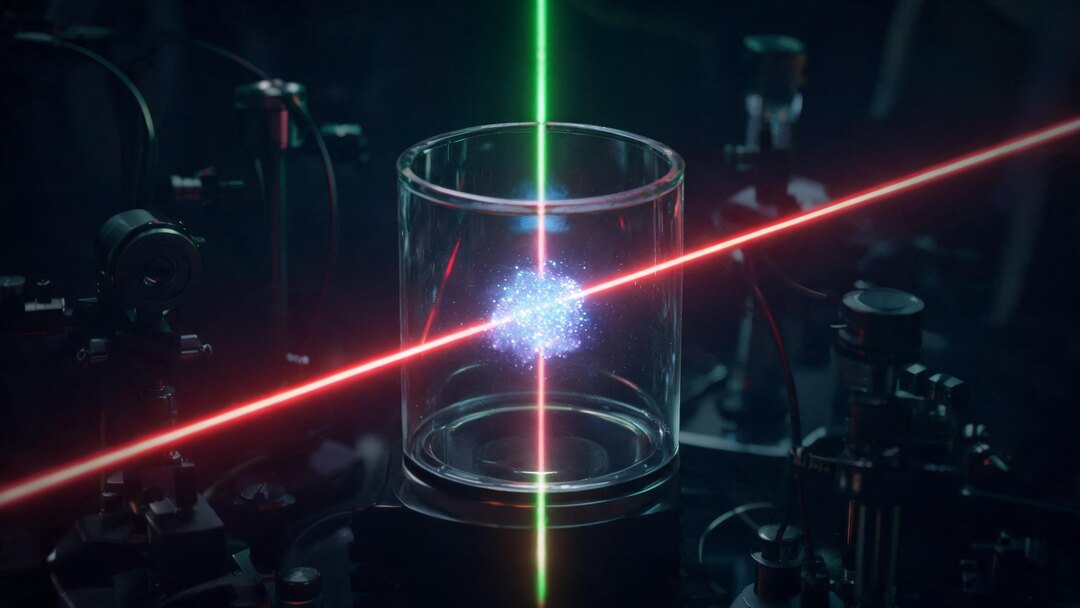
Twenty-four thousand atoms.
Only the tiniest fraction of a degree above absolute zero; lighter than dust, lighter than a breath, almost too insubstantial to call matter.
On June 11, 2026, Physical Review Research published a paper: Giovanni Barontini, at the University of Birmingham, used cold atoms to test "the problem of time."
The work sets out to probe something that has troubled physics for nearly sixty years: inside a "mini-universe" smaller than a grain of sand, without borrowing the clock on the wall, can time be defined from within the system itself?
Its title is almost defiantly plain: Testing the Problem of Time with Cold Atoms.
And seventy-one years earlier, on March 21, 1955, in Princeton, a seventy-six-year-old man took up his pen and wrote a single line to a family that had just lost one of its own:
The distinction between past, present, and future is only a stubbornly persistent illusion.
Four weeks later, he too was gone. His name was Albert Einstein.
Seventy-one years apart, the letter and Barontini's experiment approach the same question from very different directions.
Our common sense tells us that time is a river flowing forward, that "now" is always slipping away, and that those who have left are simply gone. Each of those intuitions deserves a second look.
At the end, we will return to the hardest question of all: after a loss, how should we understand the person who is no longer here?
1. The Letter
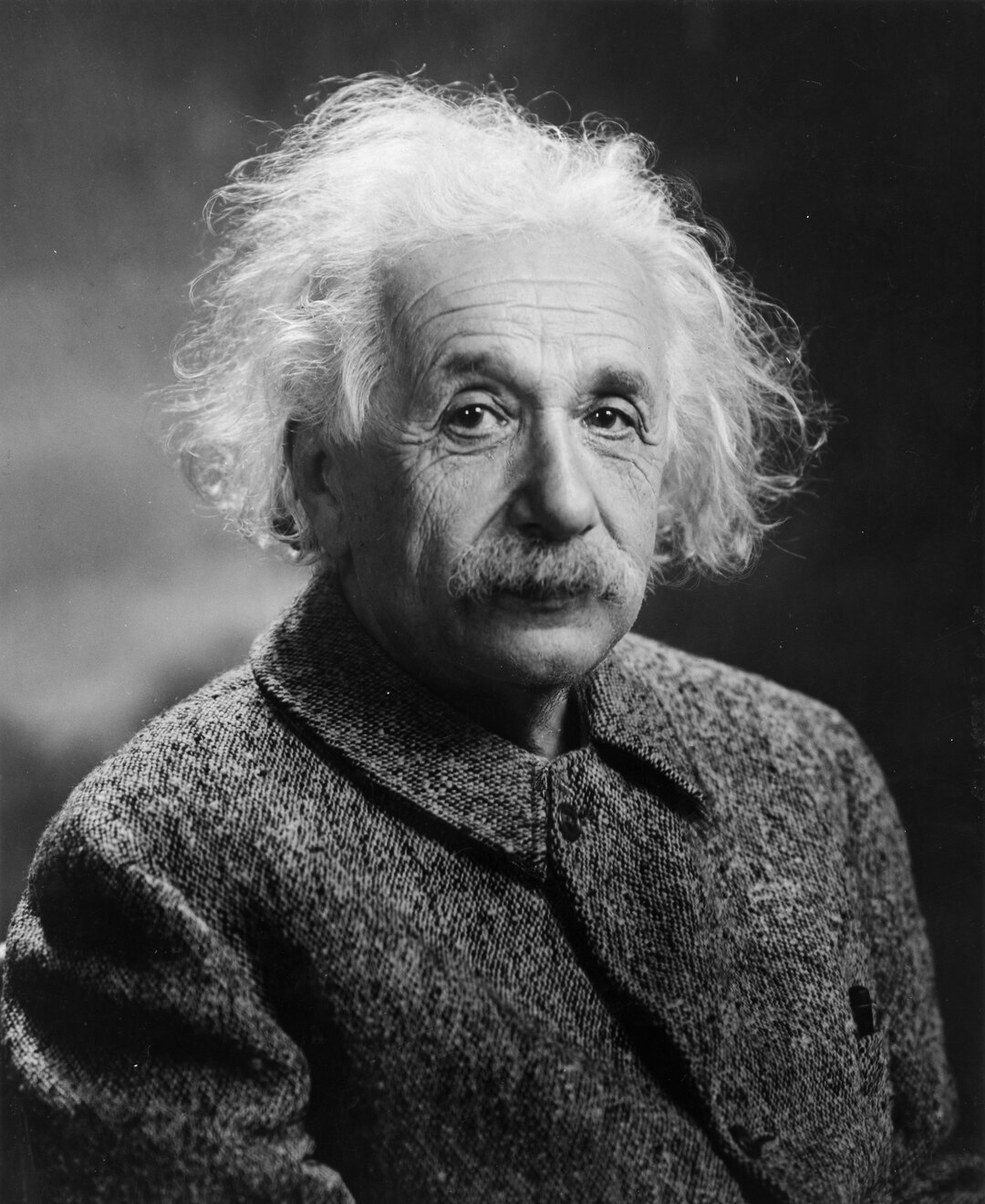
On March 15, 1955, Michele Besso died in Geneva. He had been Einstein's closest friend for most of their lives.
Early in the twentieth century, the two young men worked at the Swiss patent office in Bern. Few people knew their names. During lunch breaks they kept returning to questions that seemed remote from ordinary life: What is light? What is space? What is simultaneity?
In 1905, Einstein published his paper on special relativity and closed it by thanking "my friend and colleague Michele Besso."
Half a century later, Einstein would remember Besso this way: he was the finest "sounding board" I could imagine in my whole life.
On March 21, in Princeton, Einstein wrote to Besso's son and sister. The letter, preserved in the Einstein Archives, included these words:
He has departed this strange world a little ahead of me. That means nothing. For those of us who believe in physics, the distinction between past, present, and future is only a stubborn illusion.

Four weeks later, Einstein himself was gone. Many people read these words as his "spiritual last testament," a tender expression of hope for an afterlife.
But Einstein kept his distance from belief in a personal God, and neither the soul nor the afterlife stood at the center of his convictions. When he wrote "that means nothing," he was not making a religious promise.
What he set down was a feeling bound tightly to his own view of the physical world.
In the language of relativity, time is not a river that flows forward on its own, detached from all things. Together with space, it makes up the four-dimensional spacetime we use to describe events.
That sentence is a bit abstract. We'll make it clear with a metaphor in a moment. For now, just hold on to one possibility:
In one philosophical interpretation compatible with relativity, often called the block universe, the "past" has not been deleted from the universe; it simply is not where we find ourselves now.
This is not to say that Besso "did not die," but rather: whether the past still "is" in some way is more complicated than everyday intuition suggests.
This is also why the letter is so often read the way it is. Whether that reading is the only one, however, is not something the equations of physics can decide for us.
2. Everyone Has Their Own Time Zone
You might feel that all of this is still blackboard metaphysics. Yet the claim that time is not the same for everyone has long been a matter of calculation and test.
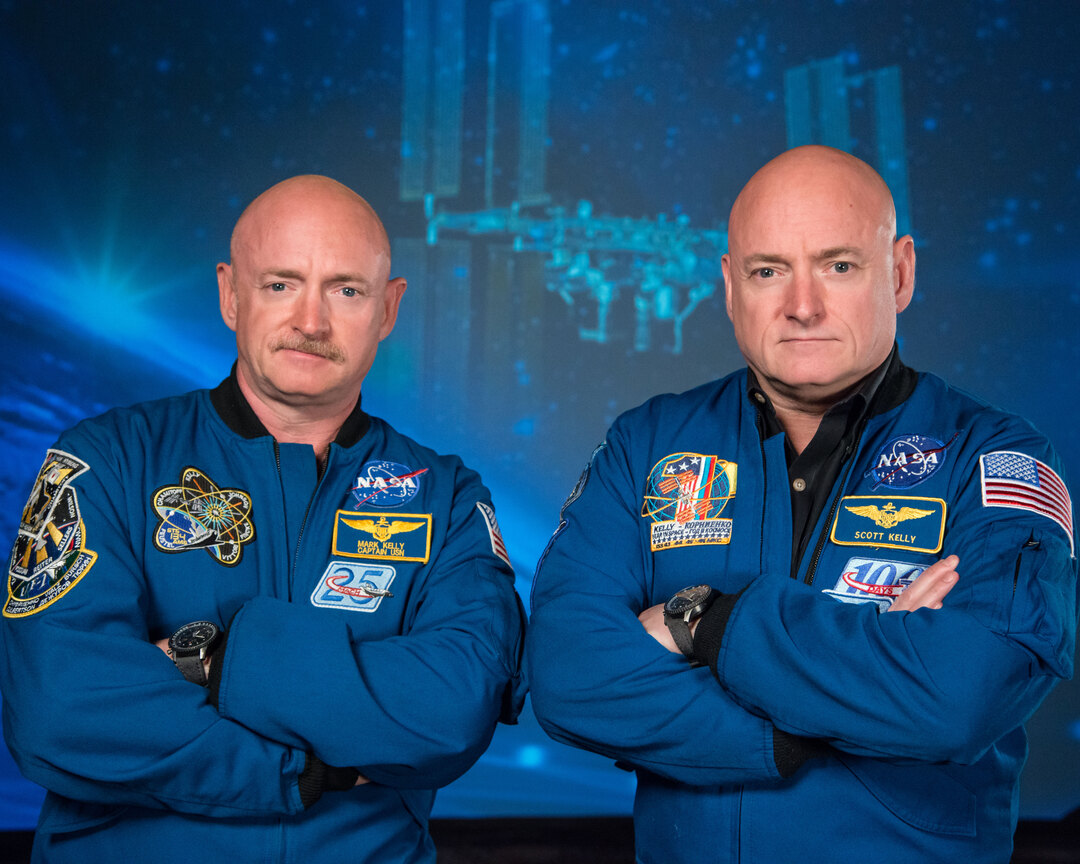
Mark Kelly and Scott Kelly are identical twins, both American astronauts. The elder brother, Mark, was born six minutes before his younger brother, Scott.
Later, Scott went up to the International Space Station and circled the Earth for 340 days, while Mark stayed on the ground.
When Scott returned, NASA applied relativity to the journey. The slowing caused by his speed slightly outweighed the speeding-up caused by weaker gravity at altitude. The net result was an increase of roughly five milliseconds in the brothers' age difference. Scott had, in that limited sense, gained five milliseconds of youth. This was a NASA-checked relativity calculation, not a physiological measurement produced by the Twins Study. It tells us something simple and astonishing:
Up in the sky, there is no great clock hanging dead center, keeping time for everyone at once.
A widely shared English passage says that everyone has their own time zone.
A Chinese saying makes a similar point: "Each fortune has its season." Some rise young; others ripen late.
Hold on to this thought. In a moment, we will first pay a visit to the edge of a black hole, and push the relativity of time to its extreme; then we will turn back and look at how physics, philosophy, and Buddhist thought illuminate one another on certain questions, while each keeps to its own boundary.
3. One Hour, Seven Years
The five milliseconds the Kelly brothers got for free are still only small change, here on Earth.
To see how far time can be stretched, you have to go somewhere more extreme: near a black hole.
There is a film that, when it ended, left many people still sitting in their seats: Interstellar.
Cooper and the others land on that ocean planet, finish their business, and return to the ship. For them, only a few hours have passed; for the crewmate who stayed behind on the ship, twenty-three years.
Cooper sits down and watches the backlog of video messages. On screen, his son grows from a boy into a father, marries, has a child, and repeatedly says, "I hope you can still see this." Then the messages stop. In the final clip, his daughter Murph has grown to the same age as the father watching her.
You might think this is something the screenwriters invented to tug at your heart.
It isn't. The person who calculated the time effects for this planet was Kip Thorne, winner of the 2017 Nobel Prize in Physics. Using general relativity, he worked out just how slowly time would run near the black hole called Gargantua; the film sets it so that one hour on the planet equals seven years outside.
Relativity gives "time slows down" two faces. One comes from speed. In Einstein's special relativity, published in 1905, faster motion means less elapsed time; the Kelly brothers' five-millisecond change came mainly from Scott's orbital speed. The other comes from gravity. In general relativity, stronger gravity makes a clock run more slowly, an effect called gravitational time dilation. That is the source of the twenty-three years Cooper loses near the black hole.
It is not far from you, either. Your phone can navigate to within a few meters because GPS corrects relativistic clock offsets every day. At satellite altitude, weaker gravity makes the clocks run faster than clocks on the ground, while orbital speed pulls the other way. Without the net correction, positioning errors would accumulate by more than ten kilometers a day.
"A day in heaven, a year on Earth" is not a mythic exaggeration. In an extreme gravitational environment, time dilation really does become significant.
Relativity contains a deeper strangeness. There is no single great clock in the sky, and there is no universal "now" shared by every observer.
Roger Penrose illustrated the point with a famous example. You and another person pass on the street, one walking east and the other west. That tiny relative motion is enough for your respective planes of simultaneity, extended millions of light-years to the Andromeda galaxy, to differ by several days. In your "now," a distant fleet has not yet departed; in the other person's "now," it has already launched. If "what is happening right now on the far side of the universe" has no observer-independent answer, then past, present, and future cannot be one universally shared river.
This is why some physicists and philosophers take the block universe seriously: the past and future may be as much a part of spacetime as the present, even though we do not occupy those locations. But moving from the relativity of simultaneity to the equal reality of past and future is an influential, contested interpretation, not a settled theorem. The view that only the present is real is called presentism; the view that past, present, and future are equally real is eternalism, the position associated here with the block universe. The debate remains open.
We will save Cooper's fall into the black hole, and the place where "all moments are laid out at once," for the end. That scene turns the question left by Einstein's letter into an image.
4. You've Secretly Wondered Too
Leave cosmology for a moment and return to your own experience. Have you ever known a moment like this?
Some summer afternoon in childhood, in your grandmother's courtyard, you lay on a straw mat watching flecks of light shift between the leaves. That one afternoon felt as long as an entire childhood.

And now a whole year slips by in the blink of an eye. Come December, you look back and can't even recall what actually happened in it.
On some night when you first fell in love, the whole city seemed to come to a halt. In those fifteen minutes waiting for your number to be called at the dentist's, time barely moved at all.
Why does time refuse to feel uniform? Why does consciousness contain a "now" that continually updates itself and pushes the past away? Why does the future, which has not arrived, still feel certain to come?
Over this past century, physics has been forced toward a somewhat uncomfortable possibility: that the "flow of time" may not be a fundamental law of the universe at all; it may instead have to do with the way we record change, organize memory, and anticipate the future.
One consistent picture is this: in certain fundamental descriptions of physics, there is no universally valid "flowing present"; and our vivid sense of "this moment" is woven together out of attention, memory, bodily rhythms, and the events around us.
This is not an answer that physics and neuroscience have jointly settled and sealed. It is a thread that different disciplines are, separately, still pursuing. In the sections that follow we'll take it one at a time: what the experiments can actually say, and what remains interpretation and conjecture.
5. When the Equation Has No Time: The Question Posed by Wheeler and DeWitt
In 1967, at Princeton, a physicist named Bryce DeWitt set out to do something ambitious: he wanted to merge Einstein's relativity and quantum mechanics into a single equation.
When he combined them, he arrived at a line so short it was unsettling, almost like a gāthā:
On the left of the equals sign is an operator describing the entire universe; on the right, a zero. The expression became known as the Wheeler–DeWitt equation, after DeWitt and John Wheeler. It is a central equation in canonical quantum gravity and attempts to describe the universe as a whole.
What kept physicists awake was not the equation's complexity, but the fact that it contains no time parameter coming from outside the system.
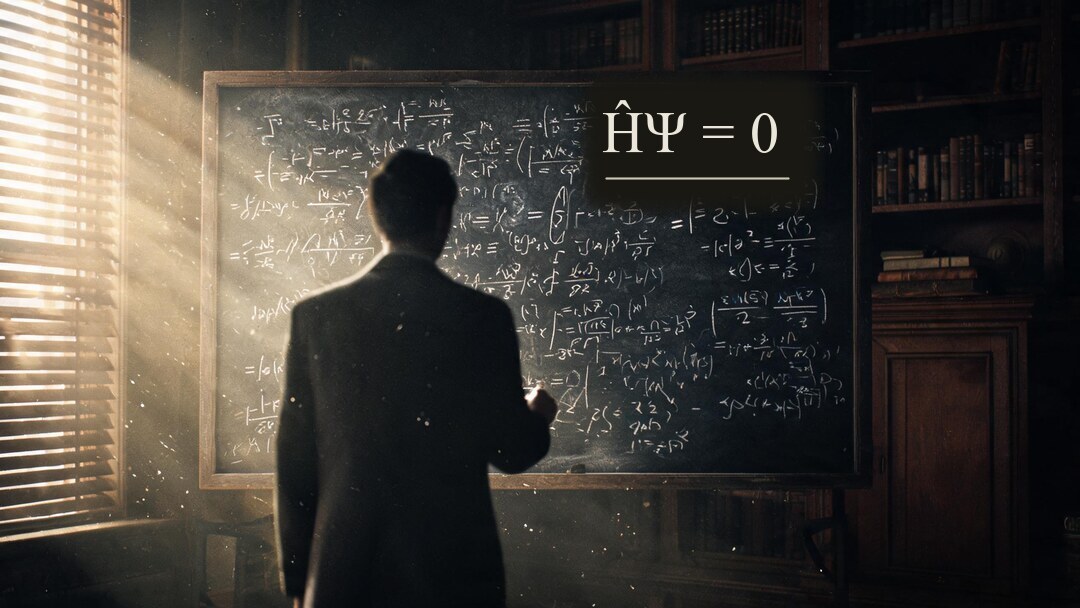
The line placed a fundamental difficulty squarely before physicists. It became part of what they call "the problem of time."
If an equation describing the universe as a whole contains no external time, where does the time we experience as a river flowing forward come from?
To this question, physicists have offered more than one answer. The most direct came in 1983.
That year, Don Page and William Wootters proposed a striking idea. A closed system may occupy a globally stationary state, yet an observer inside it can treat one subsystem as a clock and read the evolution of the rest through their quantum correlations. No external clock is required; within the system, a before and after can still emerge.
Imagine a completed photo album lying still on a table. If every page includes a clock, and the people in each image are correlated with its reading, the pages can be ordered by that internal clock. The album as a whole need not move for an evolution to be readable within it.
In 2014, Moreva and colleagues gave an experimental illustration using a pair of polarization-entangled photons. Treating one photon as a clock, an observer who reads the internal correlations sees the other photon evolve relative to it; an observer describing the joint entangled state sees a stationary whole. The same system admits relational evolution from within and a static global description from without.
Moreva's experiment tested the Page–Wootters mechanism. Later work took a different route and asked how an internal time might be built without using that two-photon entanglement scheme.
A broader family of "relational time" ideas asks whether familiar time is not a backdrop laid down in advance, but something that emerges through relations and records.
An analogy: imagine a classroom with thirty children in it. If they all sit motionless and no one speaks, the clocks do not stop, but the classroom itself contains almost no record that distinguishes "before" from "after."
But the moment they begin to speak to one another, move about, act on one another, "before" and "after" appear: A speaks first, B answers after; C stands up first, D sits down after.
On this view, time emerges from events, exchanges, and records rather than from a rail laid through the classroom in advance.
The Italian physicist Carlo Rovelli is a prominent contemporary advocate of this approach. His 2017 book The Order of Time contains a memorable line:
The world is not a collection of things, it is a collection of events.
Things change; events come to be and pass away. We usually understand "the relations between events" as "occurring within time"; relational time tries to ask it the other way around: might events and relations come first, and time be only a description we extract from them?
In 1994, Alain Connes and Carlo Rovelli proposed the thermal time hypothesis: within certain theoretical frameworks, the role of time might be reconstructed from a system's state and thermodynamic structure.
What is entropy? It is often called "disorder," but a more precise description counts the microscopic states compatible with what we observe at a coarse scale.
A cup of hot water releases heat into the cup and the surrounding air, spreading energy more widely. That is an everyday picture of increasing entropy. So is a tidy room half an hour after a three-year-old begins to play in it.
What Connes and Rovelli point out is this: our stable distinction between "past" and "future" is closely tied to entropy, to records, and to irreversible processes. If a system no longer leaves behind distinguishable change, "direction" loses any operational meaning.
A more fundamental question remains: why does entropy increase in one direction? One influential answer is that the early universe occupied an extraordinarily low-entropy state. The arrow of time is then traced back to that initial condition, a premise known as the Past Hypothesis. It is powerful, but it is not the end of every question about time.
How to turn this line of thought into a workable experiment has long been difficult.
This work, published in June 2026, used 24,000 rubidium atoms to build an experimental analogue system, quantitatively testing one method of constructing internal time out of the exchange of entropy.
6. Bright Zone and Dark Zone: Building an Internal Clock on Either Side of an Optical Barrier
We return to that cold-atom apparatus.

Barontini first cooled 24,000 rubidium atoms to near absolute zero. How cold is that?
Cold enough that these atoms no longer behave like a crowd of independent individuals, but pack together into a single, collectively vibrating "quantum cloud." In this approximation, the whole cloud can be observed as one quantum system.
This state is called a Bose–Einstein condensate. A century ago, Einstein and the Indian physicist Satyendra Nath Bose predicted the phenomenon; not until 1995 did anyone actually produce one.
Barontini then used two laser beams to cradle the cloud in an invisible "optical bowl," and a third to form a thin partition about 8 micrometers wide, roughly one-tenth the diameter of a human hair.
The partition splits this mini-universe into two halves: the lower half is a dark zone that "does not record," the upper half a bright zone that records continuously.
It is like placing a semi-transparent partition in the middle of a home fish tank, dividing it into an upper layer and a lower layer. The fish can drift slowly from the lower layer up to the upper one, and back down again.
Barontini adjusted the height of the partition much as one might change the openings in the tank's divider: smaller openings slow the atoms' passage; larger ones speed it up.
At the right barrier height, atoms flowed periodically from the dark zone into the bright zone and back again. The population of the bright zone rose, fell, and rose once more.
This is a mini-universe analogue whose cycles the researchers call a "Big Bang" and a "Big Crunch." The behavior is repeatable and measurable, but the apparatus remains a designed quantum simulator, not a shrunken cosmos.
Over roughly 120 milliseconds, Barontini recorded this breathing again and again.
To define an internal order, Barontini did not use the laboratory clock as the answer. Instead, he constructed a cumulative "entropic time" from the measurable entropy exchange between the bright and dark zones. Where exchange occurs, it advances; when exchange stops, it supplies no new ordering of events.
With a low barrier, the bright zone repeatedly passed through its "Big Bang" and "Big Crunch," while exchange between the bright and dark zones remained broadly reversible.
The laboratory clock keeps ticking, and a cycle takes tens of milliseconds. But when no new entropy exchange or internal record appears, the mini-system's "entropic time" ceases to advance.
When the barrier entered a critical range, the bright zone stopped cycling and approached a stable state the paper calls "heat death." Entropy exchange between the bright and dark zones gradually vanished; by this definition, internal time halted there.
In the paper, Barontini writes that the construction provides an internal time capable of ordering events through repeated expansions and collapses.
Barontini then derives an effective Schrödinger equation parameterized by this "entropic time." The familiar equation for quantum evolution is:
The t on the left is an external time parameter. Barontini's effective version replaces it with the system's internal "entropic time." When the entropy exchange changes slowly, the resulting dynamics locally approximate familiar quantum evolution; when the exchange is zero, ordinary unitary evolution is restored, but "entropic time" itself loses its definition.
In other words, this experiment shows that one can build a "clock" from internal entropy exchange that depends on no external timepiece; the 8 micrometers is merely the width of the optical barrier.
It echoes the question posed by Wheeler, DeWitt, and others: when a system has no external clock, can the before and after of events be rebuilt from the relations inside the system itself?
The Birmingham experiment did not settle anything for quantum gravity, but it carried this question from pure blackboard derivation to data that can be compared over and over.
Moreva and Barontini followed two distinct experimental routes. Moreva used entangled photons to illustrate the Page–Wootters mechanism; Barontini used 24,000 cold atoms to construct an internal time from entropy exchange between bright and dark sectors. The two share a concern with time defined from within a system, but the latter is not a simple scale-up of the former.
Speaking of "running entropy backward," you are probably thinking of a film: Nolan's Tenet.
On screen, the bullet is not fired but flies backward into the barrel; people walk in reverse, and rain falls up toward the sky. Nolan calls this kind of setup "inversion," and in the language of the film it is explained as the direction of entropy being reversed.
The film draws on a genuine connection: in macroscopic life, entropy and the arrow of time are closely linked. Play a familiar entropy-increasing process backward, and it looks like time reversal.
Barontini uses entropy exchange to order events inside a controlled system; Tenet turns entropy reversal into a cinematic rule. The resemblance stops there. Bullets returning to their barrels belong to fiction. Experiments can test how entropy exchange supports an internal ordering parameter and how entropy relates to the macroscopic arrow of time, but entropy alone does not explain everything about time.
7. The Universe's "Frame Rate" and "CPU": A Metaphor Worth Taking Seriously
If time emerges, what is the smallest unit in which it emerges? Physics has an extremely small timescale called the Planck time: roughly 5.39×10⁻⁴⁴ seconds.
It is built from the speed of light c, the gravitational constant G, and the reduced Planck constant ħ: tₚ = √(ħG / c⁵). At this scale, neither quantum theory nor gravity can be ignored.
But it is especially easy to slide into a misunderstanding here: the Planck time is not an already-proven "smallest unit of time," nor does it mean that the universe, like an animation, jumps one frame every Planck time.
It is more like a signpost: go to any smaller scale, and our present theories begin to be incompatible with one another; we would need a theory of quantum gravity that has not yet been finished. The unknown itself is enough to take your breath away.
Line the timescales up together, and you see something a little dizzying:

More than forty orders of magnitude separate the Planck time from a blink. From a blink to the universe's age of about 13.8 billion years adds only another dozen or so. An eighty-year life falls toward the right-hand side of this ruler, much longer than a heartbeat and much shorter than the age of the cosmos. The Planck time at the far left is not a known "smallest tick"; it is a signpost marking where quantum gravity is expected to matter.
MIT physicist Seth Lloyd offered a striking estimate from another angle:
If you treat the entire observable universe as a physical system that processes information, how many elementary operations could it, at most, have carried out over the course of its own history?
His estimate: from the early universe until now, at most about 10¹²⁰ elementary logical operations, involving about 10⁹⁰ bits of information. This is an upper bound on the total, not "10¹²⁰ times per second."
The comparison is appealing because interactions change information that can be recorded. But "CPU frequency" and "frame rate" remain literary loans. Comparing the universe to a computer is a metaphor, not a physical conclusion.
The possibility that spacetime has a discrete structure is a physical question that must ultimately face experiment or observation; loop quantum gravity and causal-set theory are among the programs that investigate it. Describing the universe as an information-processing system is a suggestive but contested perspective. "We live in the Matrix" is a film slogan. These are not three versions of the same claim.
The sharper question is this: if time has a smallest meaningful scale, is that a boundary in nature or only a boundary in our present language?
At such a boundary, science shows its discipline by refusing to fill the unknown with a pleasing answer.
8. Chang'an, 1,600 Years Ago: Another Independent Inquiry
In the early fifth century, in Chang'an, the eminent monk Kumārajīva, who came from Kucha, presided over the translation of scriptures during the Later Qin. In the traditional accounts, the area around the Xiaoyao Garden was an important translation site.
Within this tradition of translation, Kumārajīva's rendering of the Diamond Sutra has had a far-reaching influence; the full text runs to about five thousand characters.

The Diamond Sutra repeatedly asks how we grasp at "marks" or "appearances": the forms through which the mind identifies and fixes experience, not merely images seen by the eye.
The most famous passage in the sutra is in Chapter 18:
The mind of the past cannot be grasped; the mind of the present cannot be grasped; the mind of the future cannot be grasped.
The modern Buddhist scholar Master Yin Shun, in his Lectures on the Prajñā Sūtras, explains this passage with a plainness that verges on the cruel:
The mind of the past has already passed; you reach for it, and cannot hold it. The mind of the future has not yet come; you reach for it, and cannot hold it either. And the mind of the present is changing, is flowing away even now; you reach for it, and still you cannot hold it.
Imagine trying to photograph a river. The water of a second ago has already flowed downstream; the water of a second from now has not yet arrived. The water of this second becomes past as you press the shutter. None of it can be held still.
So what the Diamond Sutra speaks of is not a law of time in the physical sense, but a reminder closer to experience: the "present" you think you are holding fast has already changed in the very moment it is perceived.
Through introspection and the analysis of language, the text examines how thoughts arise and pass beyond our grasp. That inquiry may echo questions raised by Einstein, the Wheeler–DeWitt equation, or Barontini's experiment, but scientific and contemplative inquiries cannot prove one another.
Another Buddhist philosophical tradition is Yogācāra, often rendered in Chinese as "consciousness-only."
Yogācāra frames the matter more like building a house: we use "past," "present," and "future" to order experience; how these concepts come to hold cannot be separated from the participation of cognition and language.
You may label a glass "water," though the water does not know its name. You may call a cat Mimi, though the cat does not know that either.
Past, present, and future are labels that help us organize experience. That does not make them a guaranteed picture of the world stripped of all observation and relation.
It resonates with the physical inquiry into "whether time can emerge from relations"; but its object, its method, and its standard of testability are different. To hear them as echoes of each other is more measured than to declare them the same sentence.
In his 2020 book Helgoland, Rovelli discusses the second-century Indian Buddhist thinker Nāgārjuna and the Mūlamadhyamakakārikā (Fundamental Verses on the Middle Way).
Rovelli sees a philosophical resonance between relational quantum mechanics and Nāgārjuna's discussion of "emptiness," in which things do not exist in an independent, self-subsisting way.
This is not "Buddhism foretold quantum mechanics," but a philosophical kinship: when we let go of the premise that things must exist independently and self-sufficiently, the world reveals itself as more strongly relational. Kinship is not the same as identity.
9. Nine Clues, One Question Brought to Light
Lay them all out on a single table:
From physics
The Wheeler–DeWitt equation (1967): in one canonical-quantum-gravity formulation, the universe as a whole contains no external time parameter.
The Page–Wootters mechanism (1983): a globally stationary system can contain relational evolution, read through quantum correlations between a subsystem and a "clock." Moreva and colleagues illustrated the mechanism with entangled photons in 2014.
Connes and Rovelli's thermal time hypothesis (1994): an attempt to reconstruct the role of time from a state and its thermodynamic structure.
Rovelli's relational quantum mechanics (1996 onward): the value of a physical quantity is always stated in relation to another system.
Barontini's Birmingham experiment (2026): using 24,000 rubidium atoms to give a quantitative test of an experimental analogue in which internal time is built from the exchange of entropy.
Einstein's 1955 letter to the Besso family: the distinction between past, present, and future is only a stubborn illusion.
From Eastern texts
The Diamond Sutra (Kumārajīva's translation, early 5th century): the mind of the past, the mind of the present, and the mind of the future cannot be grasped.
The relevant Yogācāra discussions: the concept of time is bound up with how mind and language organize experience.
Nāgārjuna's Mūlamadhyamakakārikā (c. 2nd century): things do not exist by way of an independent, intrinsic nature; they must be understood within relations and conditions.
Nine clues, four methods, and roughly 1,900 years: mathematical physics, experiment, first-person introspection, and philosophical argument.
They do not necessarily point to one already-proven, identical answer, yet together they close in on a single question: is time the deepest background of the universe, or an experience woven together out of relation, change, record, and consciousness?
This is no one's victory. The Buddha did not foresee quantum mechanics, and Rovelli has not proven Buddhism with physics. The traditions follow different roads, yet on some questions each can change how we read the other. That is enough.
★ Within Relation: A Deeper Reminder
Reporting and association need to remain separate here. What follows is a question of experience, not a conclusion of physics, and it begins with a part of quantum theory that is easily misread.
Consider the double-slit experiment. Send electrons or photons one at a time through two narrow slits toward a screen. When no path information is recorded, the accumulated detections form alternating interference fringes, as though each particle's quantum state includes both paths. Once an apparatus reliably records which slit the particle passed through, the interference disappears, leaving the combined pattern of two single-slit distributions.
More precisely, interference is lost when path information becomes reliably encoded in a detector, the environment, or another physical system. Traditional textbooks often describe measurement in terms of "wavefunction collapse"; decoherence explains how interference is suppressed through entanglement with the environment, while interpretations still disagree about what the underlying quantum state means.
One point must be fixed firmly. In quantum mechanics, "observation" means a physical interaction capable of leaving information behind. A detector, an environmental degree of freedom, or even a passing photon that carries away path information can play that role. Human consciousness, personal attention, and belief are not required. In this context, an "observer" is first of all a physical system, not a mind willing reality to change.
When Rovelli proposed relational quantum mechanics, he pushed this line further still: a physical quantity is not an "absolute property" sitting there on its own, detached from all relation; it is always described relative to another physical system.
Read that sentence alongside the Buddhist discussion of "the seeing" and "the seen," and a certain familiarity does arise: the act of looking and the world looked upon may never have been two stones sealed off from each other.
The boundary matters most at the point where the analogy becomes intoxicating. Relational quantum mechanics does not say that a thought can change the world at will. Mixing that claim into Buddhism and quantum theory distorts both.
Relational quantum mechanics makes a more limited claim: quantum states and physical values are relative to other physical systems, not declarations from a single omniscient vantage point. It grants the human mind no special power; it only places us inside the same network of relations.
It does leave a question that is not a scientific conclusion. You can observe an electron or a galaxy, and you can attend to your own passing thoughts. But when you place the "I who is experiencing all this" inside the picture, has it already become another object of experience?
This is not a corollary of quantum mechanics. It is only a question you can carry back into your own life and take in slowly.

10. A Necessary Caution: Three Lines You Cannot Cross
Quantum mechanics, consciousness, Buddhism, and simulation arguments become especially vulnerable to pseudoscience when they are placed side by side.
One careless step, and all the serious argument that came before gets dragged into the gutter by a single line: "So the universe is just a game, right?"
Three boundaries cannot be crossed. First, saying that time may not be fundamental in some physical theories is not the same as saying that psychological time does not exist.
What Barontini's experiment showed is: in a quantum simulation system, one can construct a time parameter out of internal entropy exchange.
It did not show that the universe has been proven timeless. Nor did it abolish the time by which you wake at six, begin work at nine, or leave at five.
Our experience of duration is shaped by the brain, biological rhythms, memory, and the surrounding world. Clock time also remains indispensable for coordinating events. Your age and whether you catch the eight o'clock train are not made unreal by a theory in which time is emergent.
Even if certain physical theories treat time as non-fundamental, that does not mean you can skip getting out of bed in the morning.
The second: "discrete spacetime," "the simulation argument," and "The Matrix" are three different things.
They are often blended together, but they are not the same kind of claim. Discrete spacetime belongs to physical conjectures about quantum gravity and must, in principle, face experiment or observation. Bostrom's 2003 simulation argument is a philosophical argument built from conditional probabilities, not a result derived from physics experiments. The Matrix is a film narrative that compresses both into a memorable premise.
Conflating them makes a physical conjecture, a philosophical argument, and a film narrative equally misleading.
The third: scientific verification cannot substitute for the verification of practice.
Barontini's result is scientific because it can be repeated, challenged, and revised in the light of new data.
If the Diamond Sutra's "the mind of the past cannot be grasped" has force for you, that force comes from reading, contemplation, or life. It neither needs nor should depend on 24,000 rubidium atoms in Birmingham for proof.
The two paths differ in method, and they pose different questions; they can illuminate each other, but they cannot replace each other, and still less can they prove each other.
To say "science has finally proven Buddhism" fails both the rigor of science and the demand for real practice in Buddhism; it is a double disrespect to both sides.
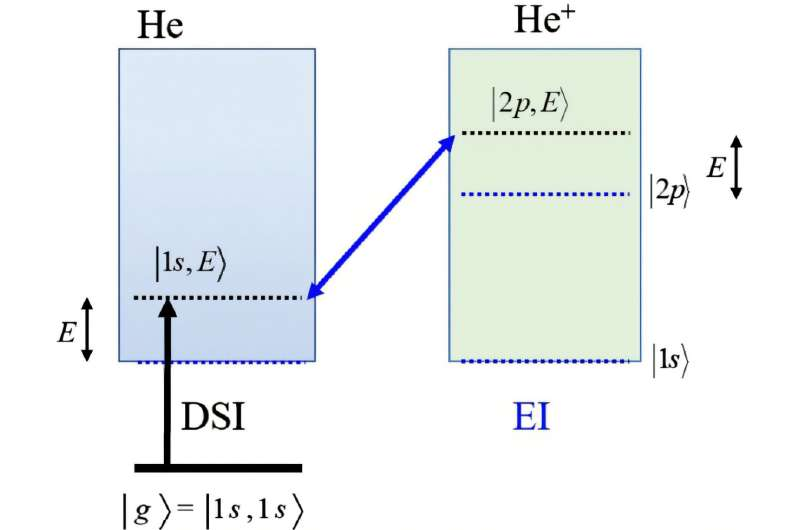
Consider a widely circulated misreading. In October 2024, researchers from Shenzhen University, Peking University, and TU Wien published a theoretical study in Physical Review Letters.
They numerically solved the full-dimensional time-dependent Schrödinger equation to simulate the ionization of helium in a strong extreme-ultraviolet field. When the outgoing electron was sorted by the energy state of the residual ion, its average "birth time" could differ by about 232 attoseconds (1 attosecond = 10⁻¹⁸ seconds). The time delay can serve as a probe of ultrafast coherence and entanglement dynamics between the electrons.
This is serious numerical work, but its quantities must be read as the paper defines them. A claim circulating on Chinese social media recast the result as follows:
Scientists have measured the speed of quantum entanglement; converting by the speed of light, the "range of action" of entanglement is 69.6 nanometers, roughly the length of 696 atoms.
That is not what the paper reports. The 232 attoseconds is neither an experimentally measured "entanglement formation time" nor the speed of a signal traveling between spatially separated entangled particles. It is an average photoelectron-emission-time difference obtained in the simulation after conditioning on the state of the residual ion.
Multiplying 232 attoseconds by the speed of light to get 69.6 nanometers, and then calling that the "range of action of entanglement," is a physically incorrect conversion.
In that TU Wien study there simply is no such quantity as "distance."
The paper asks how photoionization time delays can reveal rapid changes in interelectronic coherence and entanglement. It makes no claim about an "entanglement propagation speed."
Turning a restrained numerical study into a proclamation that it "perfectly reconciles quantum mechanics with relativity" is precisely the trap this subject invites.
The experimental judgments this essay touches on should be traced back to the original papers; philosophical interpretations and personal insights should be clearly marked as interpretations and insights.
When readers hear any sentence of the form "science has already proven…," please first ask yourself: what is the original paper, and what quantity was actually measured?
11. Not Knowing, but Stopping
This essay does not set out to convince you that "time does not exist." What it wants to say is this: that time may be emergent rather than fundamental was, for a long time, only a bold conjecture in philosophy and theoretical physics; now, at least, there are experimental analogue systems that can bring some of these internal constructions of time onto the table for testing.
The Wheeler–DeWitt equation lays the problem out; the work of Rovelli and others offers a different route. Barontini's experiment lets one such relational construction of time be checked against data. The Diamond Sutra, from yet another direction, reminds us: do not mistake a passing instant for something you can hold onto forever.
What can you do with this? Begin by letting one frame come to rest.

The next time a deadline, anxiety about the future, or regret over the past drags you along, ask what is making you feel chased: the event itself, or the story you are telling about it?
There is no need to rush toward an answer to this question. What it asks for is the single instant in which you stop.
You cannot stop time, but you may notice that the clock is not the only thing hurrying you. Memory, expectation, and inner narrative are moving too. Seeing them gives you a little more freedom within time.
12. The One You Thought Had Already Left
Return to Princeton on March 21, 1955, when Einstein wrote that brief note to Besso's family:
He has departed this strange world a little ahead of me. That means nothing. For those of us who believe in physics, the distinction between past, present, and future is only a stubborn illusion.
Four weeks later, he too was gone. The letter can be read as consolation, but physics alone does not turn it into a religious promise.
The more careful way to put it is this: Einstein's relativistic picture of the world offered him an imagination different from "the past being wiped out entirely."
One way to understand it is through the block-universe interpretation compatible with relativity, in which time is not a river flowing on its own but part of four-dimensional spacetime.
Here is an analogy. A cup sits on a table; it has length, width, height. Sunlight slants across it, and the cup casts a shadow on the tabletop.
The shadow is two-dimensional, with only length and width. It moves and changes shape, making it easy to call one of its moments its "now."
But the cup stands there whole the entire time; the shadow's morning, noon, and evening each correspond to a different relation of the cup, and none of them need be imagined as erasing the others.
Carry the analogy further, and a human life can be imagined as a four-dimensional history appearing on successive three-dimensional slices.
Birth, childhood, this moment, and the end all belong, in this interpretation, to one stretch of spacetime history. But this is a philosophical picture, not an experimental verdict on our fate.
The reason you experience "now" as moving, "the past" as receding, "the future" as not yet arrived may have to do both with the physical description and with how memory and expectation work.
This picture cannot prove that any one view of life is necessarily right, but it can make us hold the word "gone" with a little more humility.

If you have seen Interstellar, the scene is hard to forget. Cooper falls into the black hole and enters a strange place. His daughter Murph's room appears thousands of times in rows and layers: the room of her childhood, the night she slammed the door, the desk where she later worked. All of it is there at once. Cooper moves among these rooms and can knock on the bookshelf of any one of those moments.
That is the "four-dimensional cup" turned into cinema, but the scene contains two very different claims. Time dilation near a black hole is calculable, measurable physics. Falling into a five-dimensional space and sending messages into the past through gravity and love are Nolan's inventions, not laws of nature. Science and poetry can move us in the same shot without proving that love travels through spacetime.
So why does that image still bring so many people to tears? Because it takes the most abstract, most impersonal imagining about time and films it into something concrete enough to ache: a father, across time, still able to reach every frame of his daughter.
Nolan presses on another face of time in Tenet, which asks a question likely to keep you awake. If inversion let you walk backward through time, could you undo something that had already happened, perhaps even prevent your grandparents from meeting? But then who went back to change it?
The answer the film gives is: you can't. Everything you go back and do was already part of this history all along.
That is Tenet's narrative premise. It echoes a deterministic reading of the block universe, but Einstein's equations do not establish it as the only account of reality.
Seventy-one years later, in Birmingham, Barontini used twenty-four thousand rubidium atoms to demonstrate something more restrained, and more definite: within a controlled system, the ordering of events can be constructed out of internal relations such as the exchange of entropy.
This does not say "the underlying equations have already proven that time does not exist." It says: as for why time appears to flow, we can finally move part of the question onto the laboratory bench to be tested.
And in Chang'an, roughly sixteen hundred years ago, the Diamond Sutra that Kumārajīva translated lets fall, near its close, four lines of verse:
All conditioned things are like a dream, an illusion, a bubble, a shadow; like dew or a flash of lightning. Thus should one contemplate them.
The three roads do not say the same thing; but each of them keeps "past, present, and future" from remaining merely a background taken for granted.
If this discussion brings to mind someone who has died, science cannot tell you that the person still exists in some other form. The block universe is not an experimental conclusion about death or an afterlife.
It offers something more modest: a shared history does not become meaningless because it cannot be lived again. The moment you laughed until it hurt, the moment you could reach for their hand, the moment they were alive and speaking to you, all helped shape the person you are now.
This is not physics promising eternity. It is the plain fact of history: what happened is not the same as nothing having happened.
If this essay has brought someone to mind, sit with them in memory a little longer.

The person beside you now will also become someone you remember in another frame of time. Do not look only at what has passed, or live only for what has yet to arrive. The frame in which you can answer, embrace, and act is the one happening now.

Watch the video edition
References
Papers
1. DeWitt, B. S. (1967). "Quantum Theory of Gravity. I. The Canonical Theory." Physical Review, 160, 1113–1148. Link: paper page
2. Page, D. N. & Wootters, W. K. (1983). "Evolution without Evolution: Dynamics Described by Stationary Observables." Physical Review D, 27(12), 2885–2892. Link: paper page
3. Connes, A. & Rovelli, C. (1994). "Von Neumann Algebra Automorphisms and Time-Thermodynamics Relation in Generally Covariant Quantum Theories." Classical and Quantum Gravity, 11(12), 2899–2917. Link: paper page
4. Rovelli, C. (1996). "Relational Quantum Mechanics." International Journal of Theoretical Physics, 35, 1637–1678. Link: paper page
5. Lloyd, S. (2002). "Computational Capacity of the Universe." Physical Review Letters, 88, 237901. Link: paper page
6. Bostrom, N. (2003). "Are You Living in a Computer Simulation?" The Philosophical Quarterly, 53(211), 243–255. Link: full paper
7. Moreva, E., Brida, G., Gramegna, M., Giovannetti, V., Maccone, L. & Genovese, M. (2014). "Time from Quantum Entanglement: An Experimental Illustration." Physical Review A, 89(5), 052122. Link: paper page
8. Jiang, W.-C., Zhong, M.-C., Fang, Y.-K., Donsa, S., Březinová, I., Peng, L.-Y. & Burgdörfer, J. (2024). "Time Delays as Attosecond Probe of Interelectronic Coherence and Entanglement." Physical Review Letters, 133, 163201. Link: paper page
9. Barontini, G. (2026). "Testing the Problem of Time with Cold Atoms." Physical Review Research, 8, L022047. Link: paper page
Books
1. Rovelli, Carlo. The Order of Time, trans. Erica Segre & Simon Carnell. Riverhead Books, 2019, 256 pp., ISBN 9780735216112. Chinese ed.: 《时间的秩序》, trans. Yang Guang, Hunan Science & Technology Press, 2019, ISBN 9787571001636.
2. Rovelli, Carlo. Helgoland. Adelphi, 2020, 227 pp., ISBN 9788845935053. English paperback ed.: Helgoland, trans. Erica Segre & Simon Carnell, Riverhead Books, 2022, 256 pp., ISBN 9780593328897.
3. 《金刚般若波罗蜜经》, trans. Kumārajīva. The Taishō Tripiṭaka, vol. 8, no. 235 (T08n0235); CBETA.
4. 《中论》, by Nāgārjuna, trans. Kumārajīva. The Taishō Tripiṭaka, vol. 30, no. 1564 (T30n1564); CBETA.
5. Yin Shun. 《般若经讲记》. Zhengwen Publishing House, rev. ed., ISBN 9789579795579.
6. Wolfram, Stephen. A Project to Find the Fundamental Theory of Physics. Wolfram Media, 2020, 778 pp., ISBN 9781579550356.
7. Lloyd, Seth. Programming the Universe: A Quantum Computer Scientist Takes On the Cosmos. Vintage, 2007, 256 pp., ISBN 9781400033867.
8. Seth, Anil. Being You: A New Science of Consciousness. Faber & Faber, 2022, 368 pp., ISBN 9780571337729.
9. Chalmers, David J. Reality+: Virtual Worlds and the Problems of Philosophy. W. W. Norton & Company, 2022, 544 pp., ISBN 9780393635805.
10. Penrose, Roger. The Emperor's New Mind: Concerning Computers, Minds, and the Laws of Physics. Oxford University Press, 1989, 480 pp., ISBN 9780198519737.
11. Rovelli, Carlo. Reality Is Not What It Seems: The Journey to Quantum Gravity, trans. Simon Carnell & Erica Segre. Riverhead Books, 2018, 288 pp., ISBN 9780735213937. Chinese ed.: 《现实不似你所见:量子引力之旅》, trans. Yang Guang, Hunan Science & Technology Press, 2017, 231 pp., ISBN 9787535795489.
12. Carroll, Sean. From Eternity to Here: The Quest for the Ultimate Theory of Time. Dutton, 2010, 448 pp., ISBN 9780525951339.